
Asia’s AI horizon – Asia trip insights (Brisbane)
Pitcher Partners Wealth Management (Brisbane) | The information in these articles is current as at 20 July 2026
With AI being all the rage in financial markets, we recently undertook a research trip up to Asia to gain a better understanding of what is happening in the technology supply chain and particularly the broader AI ecosystem.
Our visit included attending a broker conference where we had an opportunity to meet a number of companies and leading industry experts. We met with equipment suppliers, large-scale language models (LLMs), neocloud operators, data centres, hyperscalers, and companies integrating and using AI at scale across their organisations. We also spent time gaining a better understanding of future technology and AI uses, such as automation, robotics and autonomous vehicles, as well as other sectors where AI can come to play a vitally important role in future, such as healthcare, space technology and other areas.
We undertook further site visits to companies in the AI and wider technology supply chain, including manufacturers of AI server racks, firms at the leading edge of connectivity and networks of data centres and AI, as well as testing equipment manufacturers.
Technology cold war
Geopolitically the split between the US and China has been growing the last number of years, particularly in matters regarding AI and technology. This is witnessing the emergence of two distinct markets, one dominated by US, and one dominated by China.
This has seen the emergence of two separate supply chains, mostly at the more advanced end. The US aiming to restrict China’s access to advanced technology and processes, while China has sought to restrict the US from accessing rare earths that are increasingly vital to the overall supply chain.
AI with Chinese characteristics
AI demand is not growing in a linear manner, it is going exponential, growing faster than conventional models can capture. As we move from training to inferencing, and query to agentic, demand and usage will likely stay exponential.
While the US focus is on building the LLMs, becoming champions in the key AI models, and focusing on enterprise adoption, China is about applications and industrial automation. China is deploying AI across the economy, embracing open claws and integrating AI into super-apps. China is democratising AI, turning it into a utility for everyone.
China has quietly, but very effectively, been building its own capability across the entire supply chain, and continues to develop this further, at a rapid scale. And as access to affordable power is becoming increasingly difficult in North America, the Chinese firms have abundant access to affordable power, delivering a huge cost advantage.
China additionally has a huge AI market. Doubao, one of the Chinese LLMs, alone reaches over 100 million daily active users. Token volumes are equally vast. By the early part of this year, Chinese token volumes had significantly overtaken those of the main US/Western providers, according to data from OpenRouter. China’s compute stack is doing double duty – supporting model training and serving hundreds of millions of consumers, and a rapidly growing base of enterprises, through consumer super-apps like WeChat, Doubao and Alipay.
Open source models
Chinese AI will play a significant role. The phrase ‘it can do 70-80% of the tasks but at 20% of the cost’ was oft repeated in our meetings. China is moving very fast in AI, a lot closer to US peers than many currently recognise.
Weekly token consumption of top 9 models through OpenRouter API calls, Trillions of tokens
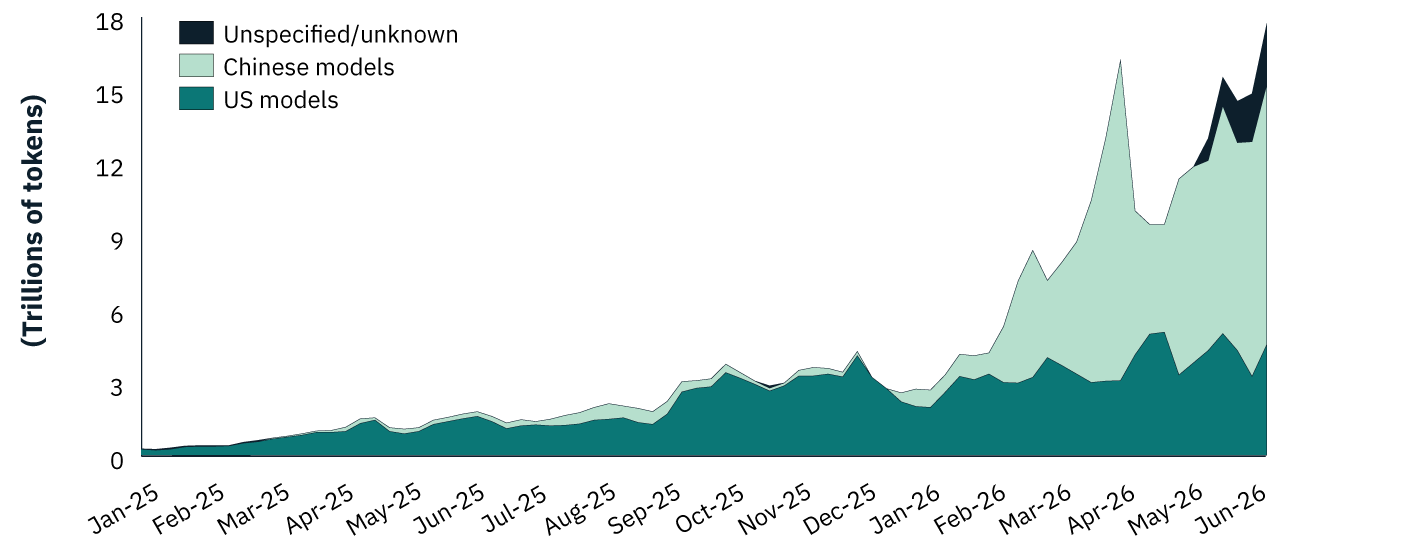
The models developed in China differ from the US models primarily in that they are open source, offering high transparency, data sovereignty, and cost efficiency, allowing customers to fine-tune and run them locally or on private servers. This allows for more rapid roll-out of the models and increased usage via applications.
Over the course of the trip, the view that we are unlikely to see a ‘winner takes all’ scenario taking place became increasingly entrenched. We are likely heading towards a combination of using big and small models, with smaller AI models much more task-specific. The open source nature of the Chinese models lend themselves very well to this. China’s strong position in electrification and power access, manufacturing scale and the small gap in capability vs the US models bodes well for its use across applications.
The chief difficulty the Chinese LLMs are having, like everyone else, is how to monetise the AI to an extent where there is a return on the massive investment made in developing these AI features and models.
The strong position of the Chinese models and their much lower token cost, also holds potential to restrict pricing power across the entire market and ecosystem, thus potentially depressing returns for the AI models. Great for us all as consumers, but less great for those who have invested large sums into the development of these models. This could present a significant dilemma for the US models and their ability to generate an adequate return on investment, particularly given the eye-watering amounts of capital being invested in their development.
The tech supply chain
As the spend continues to ramp up in this race to deploy AI, the supply chain is showing signs of stress. There have been numerous stories of supply chain disruptions across several different niche inputs, and these are likely to persist. From our conversations with firms in the technology supply chain, there is far more demand than supply chain can deal with.
The supply chain is fragile and there are lots of areas where vulnerability and shortages can occur. Memory chips, which have come to prominence for the huge price increases we have seen due to a shortage of capacity, are a clear example, but we also heard of supply chain constraints in printed circuit boards, chemicals, substrates, wafers, glass fibre, coatings etc. Added to this, the huge demand is also witnessing supply times becoming very tight and getting shorter. One firm mentioned that their order flow was previously 9-12 months in advance, with that now having shortened to less than 2 months, and this for bespoke equipment.
Conclusion
China has already shown its prowess in advanced technology, through its dominance of electric vehicles, and its position dominating the global supply chain, puts it in a strong position to play a leading role in new technologies to come. As we move into the age of physical AI, with humanoids, robotics, and autonomous vehicles, China will likely play an even greater role than currently.
China benefits from the proximity of the supply chain, which has all been built out at scale in the country, thus giving it a massive advantage in manufacturing and developing solutions in these industries. Given its dominance of the supply chain, physical AI cannot happen without China.
We have already witnessed the first so-called ‘DeepSeek moment’ in early 2025, when the Chinese LLM shocked the world with its ability despite far less capital investment, and the near future likely holds several similar ‘DeepSeek moments’ to come.