
A practical approach to planning before 1 July 2027
Key points
- From 1 July 2027, CGT reforms will allocate gains on affected assets between pre- and post-transition gains.
- Taxpayers may be able to use a formula-based apportionment method that assumes steady compounded growth, but this may not reflect when value was actually created.
- Planning before 1 July 2027 can preserve flexibility to obtain a retrospective valuation while relevant information remains readily available.
Overview
From 1 July 2027, CGT reforms will change how gains on affected assets are calculated and taxed. For assets already owned by individuals, trusts and partnerships at that date and sold later, the gain will be allocated between growth before and after the transition date.
Treasury has released a proposed apportionment method for real property and assets without a readily ascertainable market value. The proposed formula allocates growth across the holding period assuming the asset’s value grows at a steady compounded rate over that period. In practice, value may not grow this way, which means the formula may not reflect when value was actually created.
Relevant asset owners may therefore need to choose between using the formula and establishing the asset’s market value at 1 July 2027.
Why keeping your options open matters
Businesses and other assets rarely grow evenly over time. Value can change significantly when market conditions shift, a business evolves, a major contract is secured or an asset is repositioned. The value attributed at 1 July 2027 under the proposed formula may therefore differ from market value at that date.
A comprehensive valuation may not be necessary in every case. Depending on the circumstances, the appropriate action could involve preserving relevant information for future use, preparing an initial view on value or obtaining a comprehensive valuation.
Understanding your options
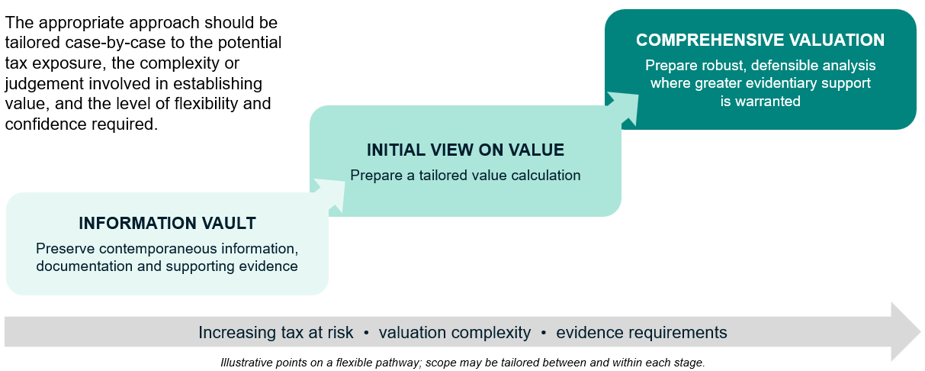
Not every asset warrants the same level of analysis. The appropriate approach depends on the circumstances, including the potential tax exposure, the complexity or judgement involved in establishing value, and the level of flexibility and confidence required.
The following alternatives are points along a spectrum of possible approaches. Each may be tailored to the circumstances.
1) Preserve the information
Where a valuation is not warranted at 1 July 2027, preserve the relevant financial, market and other information available at that time. This keeps open the option of undertaking a valuation later if circumstances change or greater confidence is required. Reconstructing that information years later, from memory and incomplete records, may be more difficult and easier to challenge.
2) Obtain an initial view on value
Prepare a tailored value calculation using information available at 1 July 2027. This can provide an initial indication of value without necessarily undertaking a comprehensive valuation. Retaining the underlying information can also assist if a more comprehensive valuation that satisfies ATO guidelines is required later.
3) Obtain a comprehensive valuation
Where greater confidence is required, consider a more comprehensive market valuation at or near 1 July 2027.
Tailoring the approach to establishing value
Illustrative CGT payable scenarios
This example compares how the apportionment method under the proposed formula and supported market valuation could allocate the same overall gain differently. It illustrates the potential effect of uneven value growth and is not intended to predict the outcome for any taxpayer.
| Key assumptions | Value | Note |
| Entry date | 1-Jul-24 | Scenario start date for holding period and return calculations. |
| Transition Date | 1-Jul-27 | CGT reform commencement date. |
| Exit date | 30-Jun-30 | Scenario end date for holding period and post-transition indexation calculations. |
| Entry value ($m) | $10.0 | Scenario entry value. Transaction and other cost-base items excluded. |
| Exit value ($m) | $30.0 | Scenario exit value. Selling costs and other CGT adjustments excluded. |
| Formula-based value ($m) | $17.3 | Entry value daily compounded to Transition Date. |
| Valuation at Transition Date ($m) | $25.0 | Assumed supportable market value at Transition Date. |
| CGT discount | 50% | Assumed 50% discount for eligible pre-transition gains held at least 12 months. |
| Marginal tax rate | 47% | Top individual rate assumption: 45% income tax plus 2% Medicare levy. Other taxpayers may differ. |
| Annual inflation | 2.5% | Inflation assumption, based on the midpoint of the RBA’s 2–3% target. |
Based on these assumptions, the graph below illustrates the different value paths under the formula and valuation scenarios:
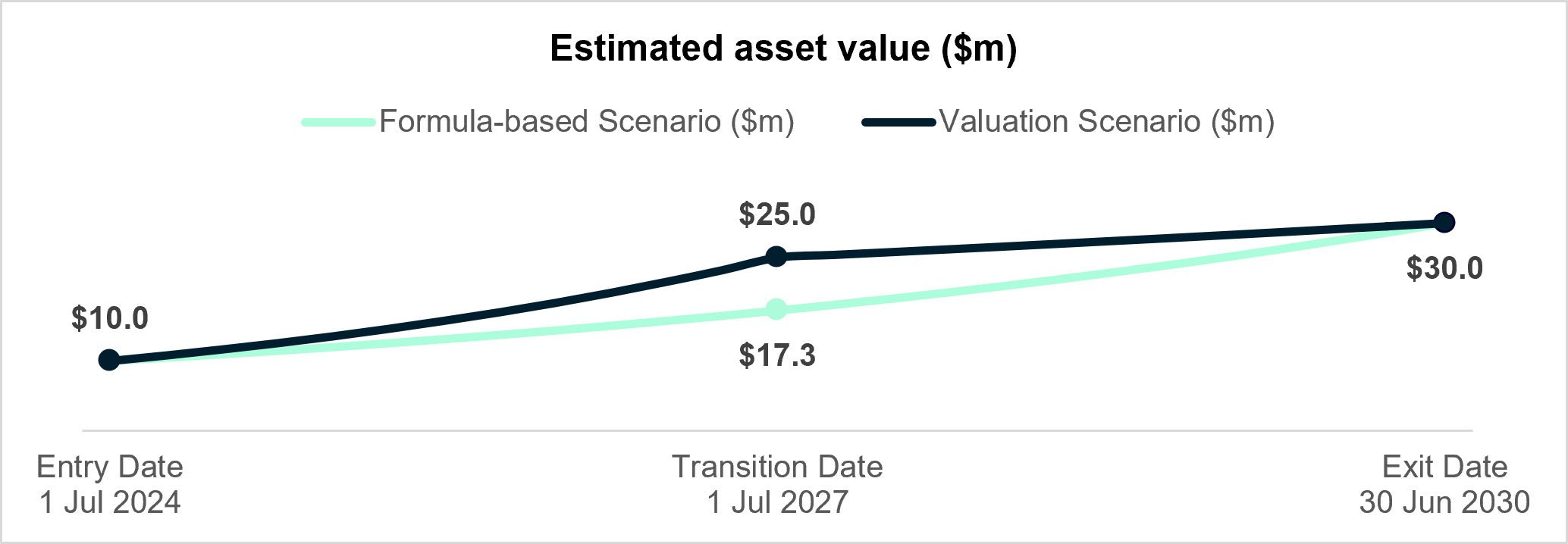
In this example, the valuation attributes more of the total gain to the period before 1 July 2027 than the formula. The resulting allocation of gains and illustrative CGT outcomes are summarised below.
| Outcome | Market valuation scenario ($m) | Proposed formula scenario ($m) | Difference ($m) |
| Value attributed at Transition Date | 25.0 | 17.3 | 7.7 |
| Pre-transition gain | 15.0 | 7.3 | 7.7 |
| Post-transition gain | 5.0 | 12.7 | (7.7) |
| Post-transition real gain | 3.1 | 11.3 | N/A |
| Illustrative CGT payable | 5.0 | 7.1 | 2.1 |
| Effective tax rate | 24.9% | 35.3% | 10.4% |
Based on these assumptions, total CGT is $5.0 million under the valuation scenario compared with $7.1 million under the formula scenario, a difference of $2.1 million.
A valuation will not always produce the lower tax outcome. If more of the asset’s growth occurs from 1 July 2027, the formula may be more favourable. Where the proposed formula method is available, taxpayers may have a choice between establishing market value and using that method.
Conclusion
There is no single approach that will be right for every asset. What is appropriate will depend on the potential tax at stake, how difficult or judgemental it is to establish value, and how much flexibility and confidence is required.
The important step is to consider these factors before 1 July 2027, while the information needed to support value is readily available. For some assets, preserving the relevant information may provide sufficient flexibility. For others, an initial value calculation or a comprehensive valuation may provide the additional confidence required.
The key is not necessarily to undertake a comprehensive valuation at 1 July 2027, but to make an informed decision that keeps options open. Preserving the right financial, operational and market information will keep options open and make it easier to support an appropriate value if the asset is sold in the future.
FAQs
Which assets may be eligible for the formula method?
The formula is intended for real property and assets without a readily ascertainable market value. Eligibility will depend on the final legislation and the particular asset.
How does the formula allocate growth?
It applies a steady compounded growth assumption across the holding period to determine the value attributed at 1 July 2027.
Can a valuation be prepared after 1 July 2027?
Yes. However, a later valuation may be more difficult to support as time elapses if key financial, operational and market records are incomplete.
What could cause the formula and market valuation outcomes to differ?
Differences may arise where value changes unevenly over the holding period.
If a valuation is obtained, must it be used?
Where the formula method is available, taxpayers may be able to choose between establishing market value and applying the formula, allowing the preferred approach to be determined when the relevant CGT event occurs.
Note: This article is general in nature and does not constitute tax advice. It is based on tax legislation, ATO guidance and Treasury announcements available at the date of publication. The formula-based apportionment method discussed in this article remains subject to finalisation and may change.