

When the benchmark becomes the bet
Global equity indices are increasingly dominated by a small number of very large companies. While some investors may have chosen this exposure deliberately, an allocation that appears low-cost and conservative has, in many portfolios, evolved into a sizeable unintended bet. As few active managers have consistently outperformed, their more relevant role today may be to provide an alternative to concentrations that index funds cannot avoid.
The rising concentration of global equity indices
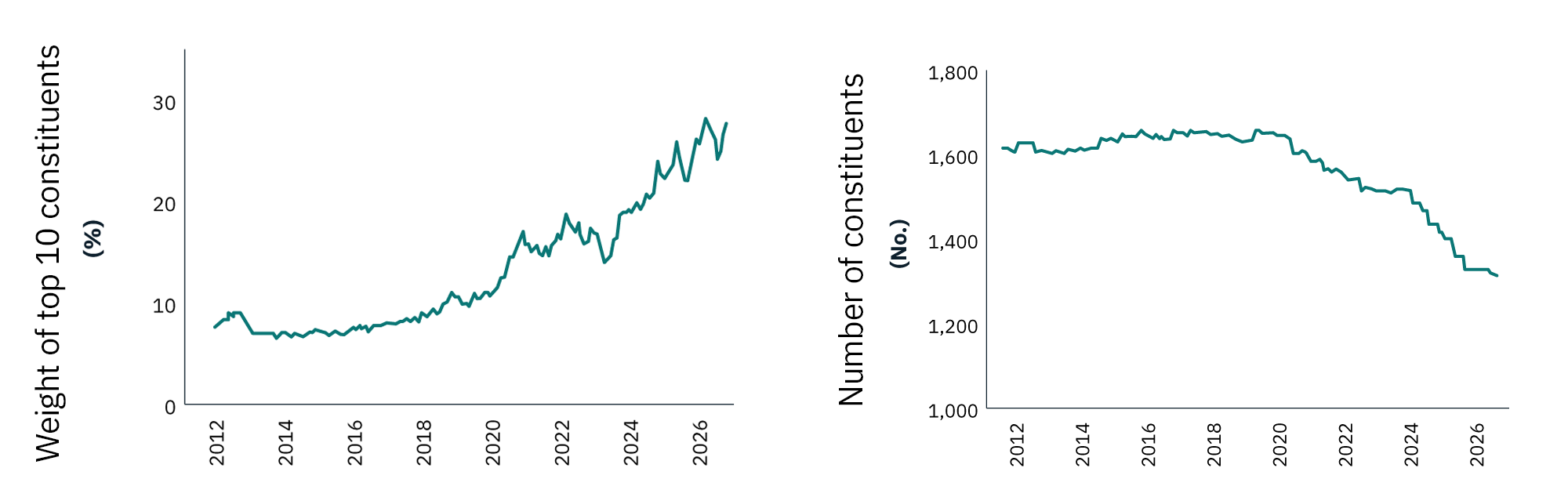
Passive investing began as a low-cost way to gain broad exposure to an economy. Benchmarks such as the S&P 500 represented a broad cross-section of the US corporate sector, while index funds provided simple, inexpensive access to long-run economic growth. In market-capitalisation-weighted indices, outperforming companies receive progressively larger weights, increasing the index’s dependence on them. According to MSCI, the ten largest companies represented roughly 10% of the MSCI World Index in early 2012; by mid-2026, their combined weight had roughly tripled, with much of the increase occurring after 2020 (Exhibit 1).
Concentration is also changing the composition and design of indices. As the largest companies account for more of global market capitalisation, the threshold for inclusion rises, meaning smaller constituents can fall out without any deterioration in their fundamentals. Since 2020, the MSCI World Index has lost more than 300 constituents, most outside the United States. MSCI is now examining how methodology changes could improve index breadth, while alternative benchmarks have emerged. S&P Dow Jones Indices, for example, launched the S&P 500 3% Capped Index in 2024, limiting each company to a 3% weight at quarterly rebalancing. These developments show how difficult index concentration has become to ignore.
MSCI World: Weight of top 10 constituents and constituent number since January 2012
Exhibit 1: A bigger share of the market is being driven by fewer companies
Source: MSCI, Market Concentration and the Global Index Opportunity Set, August 2026.
The pressure is not limited to the growth of existing index constituents. Recent mega-cap IPOs can add another dimension to concentration risk. SpaceX began trading on Nasdaq on 12 June 2026 and was announced for inclusion in the Nasdaq-100 just two weeks later. In other words, a company with only a fortnight of public-market history became part of one of the world’s widely tracked benchmarks, generating index-related demand before the market had much time to establish a trading record or test its valuation across different conditions. A similar dynamic could emerge with Anthropic, which is preparing for an IPO reportedly targeting a valuation of several trillions and could potentially enter the benchmark universe as another newly listed mega-cap with very limited public-market history.
The result is something of a diversification paradox. An investor can own more than a thousand companies across the world and reasonably believe the portfolio is broadly diversified, while a disproportionate share of its returns may still be determined by little more than a dozen businesses exposed to similar technology and AI-related drivers. This is particularly pronounced in the United States, where a growing share of major equity indices is now tied directly or indirectly to the technology cycle. Whatever the quality of those businesses, it represents a substantial common exposure that passive investors carry regardless of their own view on valuation, concentration or the durability of that technology cycle.
What history suggests about periods of peak concentration
Over the past decade, US investors have withdrawn trillions of dollars from active equity funds while index strategies have attracted trillions more. A similar shift has occurred in Australia, where ETFs and large institutional investors, including superannuation funds, have become dominant drivers of equity-market flows. Because active funds generally hold less of the largest companies than their benchmarks, capital moving from active to passive strategies can reinforce concentration by redirecting a greater share of flows towards the biggest stocks. As those companies rise, their index weights increase, while the active managers most inclined to lean against the trend often face outflows and growing relative-performance pressure.
None of this suggests that the largest companies are about to falter. Earnings growth across the major technology companies remains strong, and they may continue to outgrow the rest of the market for some time. Instead, the point is that today’s index increasingly depends on that dominance continuing. S&P Dow Jones Indices research covering three decades of US sector data found that when sector concentration ranked among the highest in its history, it declined over the following five years 82% of the time.
If concentration does begin to unwind, the opportunity set for active managers could improve materially. Over the past three decades, equal-weighted indices have tended to outperform their cap-weighted equivalents following concentration peaks, while managers that remained underweight in the largest companies may recover some of the relative performance cost of doing so. Stock-level dispersion has also widened sharply, with S&P Dow Jones Indices data showing the gap between the best and worst-performing companies reaching levels in the first half of 2026 last seen around the Global Financial Crisis. Greater dispersion gives fundamental research more scope to matter.
A broader market decline could accelerate that process. Index funds sell in much the same way they buy: mechanically and in proportion to size, meaning the companies that benefited most from price-insensitive buying on the way up could also face the greatest selling pressure on the way down. The 2022 interest-rate shock provides a useful, though imperfect, illustration. The Nasdaq-100 fell by around 34%, compared with roughly 24% for the S&P 500. The comparison is obviously not purely a concentration effect, as the Nasdaq-100 also carried materially greater technology exposure, but it does show how concentration can amplify losses when it overlaps with a dominant factor exposure. More broadly, when index concentration is tied to a common theme such as technology or long-duration growth, those risks can reinforce one another as sentiment reverses. In such an environment, concentration can become a more meaningful source of portfolio risk.
Rethinking the role of active management in equity portfolios
Paying an active equity manager has traditionally meant paying for the possibility of outperforming the benchmark, and the long-term evidence suggests that many investors did not ultimately receive that outperformance over the past two decades. The growing concentration of equity indices, combined with elevated valuations across many major markets, has, however, introduced a good reason to consider a genuinely benchmark-agnostic active manager. An index fund has no ability to step aside when prices dislocate or to take advantage of periods of market stress. By contrast, an active manager with a consistent valuation discipline can own less of an increasingly crowded company, hold what the index is discarding and deploy capital when forced or mechanical selling creates opportunity. With much of today’s market concentration linked, directly or indirectly, to the broader AI and technology theme, the ability to deviate meaningfully from the index has become increasingly important.
The potential sources of excess return may also be changing. The traditional case for a global equity manager rested heavily on superior company research and the ability to identify information or insights not yet fully reflected in prices. In today’s market, an equally important advantage may be the ability and willingness to hold what flow-driven capital cannot.
The case against active management nevertheless remains real. Fees compound against investors over time, the average equity manager is still likely to lag after costs, and strong past performance has historically been a poor guide to outcomes over the following five years. The bar for paying an active manager should therefore remain high. This places the emphasis on equity manager selection and reframes what investors should look for. A clear valuation discipline is important, as is a willingness to own meaningfully more or less of a company than the index does. Equally important is a business built for patience, because any portfolio that differs from the index will look wrong at times.
Index funds remain an efficient way to own the market, but the nature of that exposure has changed. In many portfolios, index investing now represents a sizeable and potentially unintended allocation to technology and AI-related risks, which could amplify losses if sentiment weakens and passive flows reverse. Index exposure should therefore be held deliberately rather than by default, alongside active managers capable of managing concentration and valuation risk.