
The resilience of Australian retail property
Australian retail property has emerged from a turbulent few years as the standout performer across the commercial real estate landscape. After absorbing the largest sector-wide repricing in roughly 35 years, retail delivered the strongest total return of all commercial property sectors in 2025 and carried that momentum into 2026. This note examines the foundations of that resilience, at both the asset and consumer level, while acknowledging, the genuine headwinds now testing the market.
The case for retail property begins with the consumer. Australia’s economy proved resilient through 2025, supported by earlier interest-rate cuts and a strong labour market, with employment growth solid and unemployment holding at low levels. Population growth over the past 10 years of around 1.5% p.a. (per the Australian Bureau of Statistics (ABS), which captures a noticeable impact from covid in 2020-2021), continues to expand the consumer base which underpins every shopping centre’s catchment. Going forward, the ABS population projection points to a rise from roughly 27.8m in 2025 toward 32m by 2035 — a structural tailwind few other markets can match.
That said, 2026 is shaping up as a year of recalibration rather than acceleration. Inflation has re-accelerated, with the Consumer Price Index (CPI) rising to 4.6% in the year to March 2026, and the Reserve Bank of Australia (RBA) has responded, by lifting the cash rate to 4.35% with three consecutive increases this year. With the cost impacts from the Middle East along with Russia-Ukraine conflicts and a Federal Budget that is expected to impact house prices, it’s not surprising recent consumer-sentiment data suggests confidence has begun to soften, particularly in discretionary categories. For property owners, the implication is a market defined less by easy capital-value growth and more by income durability with the ability to grow rents ahead of inflation.
Despite cost-of-living pressures, household spending has held up remarkably well with that resilience extending across the tenancy spectrum. Supermarket and discount department store anchors continue to drive reliable, non-discretionary foot traffic, creating spillover visitation for the specialty stores around them. Specialty productivity remains the clearest barometer of a centre’s health, and the very best centres demonstrate just how strong it can be. Scentre Group, home of the Westfield shopping centres in Australia, recorded moving annual turnover improvement for the 12 months to 30 June 2026 of 4.2%, with specialty sales growth of 5.4%. Encouragingly, occupancy cost ratios in regional and sub-regional centres now sit below pre-2020 levels, with the largest reductions in Fashion and Services categories, creating headroom for specialty rents to grow at mid-single-digit rates through 2026.
The long-feared structural displacement of physical retail assets by online channels has not materialised in the way the “bears” predicted. Online retail has continued to grow, but it has settled into a share of total trade that physical centres have learned to work with rather than against. Needs-based and experiential offerings: creating community-focused lifestyle hubs that incorporates supermarkets, medical and allied health, dining, services and entertainment offerings are typically least exposed to online substitution, and have become the engine room of centre visitation.
Perhaps the most powerful structural support for the sector is the near absence of new supply. Construction costs have surged by roughly 30% over the past five years, and land prices have outpaced rents, widening the cost-to-rent gap to the point where new development is frequently unviable without a major supermarket anchor. New supply across the wider commercial market is expected to fall to between 20% and 50% of historical levels for the remainder of the decade. When new retail supply does proceed, it’s dominated by Large Format Retail and Neighbourhood centres aimed at servicing population growth, while regional and CBD activity is largely refurbishment and extension. With asset pricing still sitting well below replacement cost, the economics strongly favour a buy-over-build strategy — and existing, well-located centres are positioned to capture the rental growth that scarcity creates.
National retail property supply by sub-sector (sqm)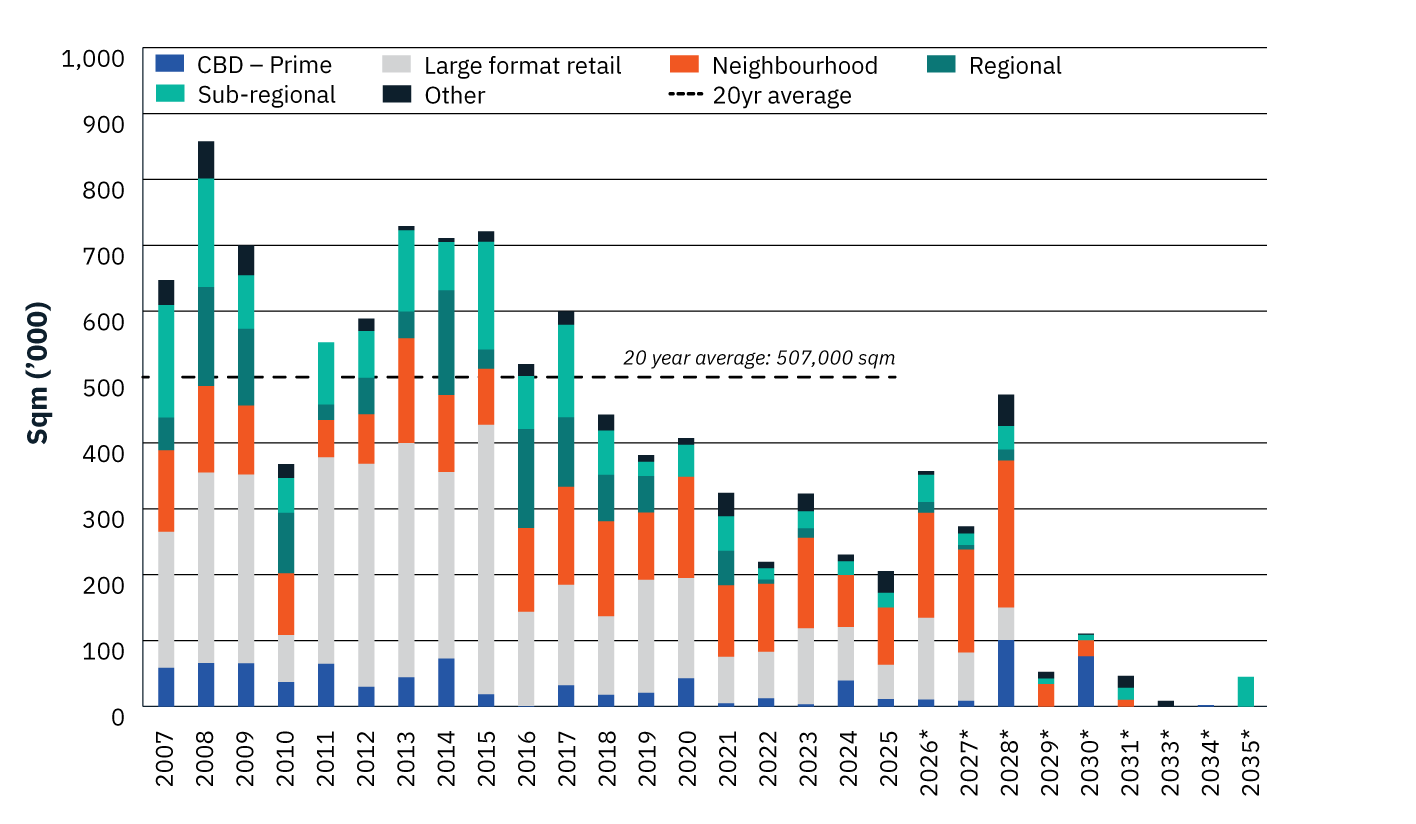
Source: JLL, Charter Hall Research. At 1Q26
Reading the sub-sectors
Performance within retail property is far from uniform, and asset selection is increasingly the determinant of returns. Three formats warrant particular attention.
Neighbourhood (grocery-anchored) centres
These daily-needs centres are the most defensive segment of the market. Anchored by a full-line supermarket and weighted towards non-discretionary spend, they offer durable, often inflation-linked income and have posted sector-leading investment returns over the past decade. Strong rental growth, tight vacancy and institutional appetite for convenience-led income make them the preferred entry point for capital seeking defensive exposure, retail’s equivalent of a blue-chip stock.
Large Format Retail
Large Format Retail (LFR) has been outperforming the rest of the retail market on rental growth. The format benefits from low occupancy costs, big-box anchors such as Bunnings spanning DIY and trade demand, and a growing curation of lifestyle, wellness and casual-dining uses. LFR accounts for the largest share of the (modest) new-supply pipeline at roughly 42%, reflecting both its relevance to population growth and the comparatively lower cost of delivery.
Fortress and regional “super” malls
Dominant, hard-to-replicate regional and super-regional centres (the so-called fortress malls) combine scale, depth of tenant mix and high sales productivity. Tight space at the top end is pricing some tenants down into sub-regional centres, lifting rents there too. Dominant, hard-to-replicate regional and super-regional “fortress” malls serve as prime examples of supply-constrained assets due to prohibitive construction costs and the extreme scarcity of viable, high-quality metropolitan land parcels needed to support new development.
Looking ahead
Australian retail property has earned it’s standing the hard way. It has absorbed the deepest repricing in a generation before emerging in 2025 as the strongest-performing commercial sector, underpinned by a resilient consumer, constrained supply and a return of institutional investment capital. Looking ahead, renewed inflation and higher interest rates will temper the pace of recovery with investors keeping a measured eye on discretionary exposure. With future returns increasingly driven by income growth rather than yield compression, the next 12 months is shaping as a year that rewards investor discipline, asset selection and active management.