

Private credit: Looking beyond the AI headlines
Private credit has become one of the fastest-growing asset classes globally, but recent headlines have raised questions about the implications of AI for specific industries in the market. Much of the discussion has focused on US retail-oriented private credit vehicles with relatively high exposure to software companies, creating a narrative that has often overshadowed the broader fundamentals of the asset class. This article examines the underlying drivers of recent developments and explains why institutional private credit continues to present a more balanced picture than recent headlines imply.
Key points
- AI-related concerns are real but concentrated within software-heavy lending portfolios rather than the broader private credit market.
- Default rates have risen modestly but remain contained, particularly in senior secured lending where institutional investors are most active.
- Retail investors have become more cautious, while institutional investors and insurers continue to allocate capital to the asset class.
- Market volatility and weaker fundraising are improving lending conditions through wider spreads and stronger lender protections.
- Asset-based finance provides diversification away from corporate credit and sectors most exposed to AI disruption.
A market dominated by an AI narrative
Halfway through 2026, the dominant story surrounding private credit is no longer credit quality, interest rates or economic growth – it is AI. Headlines have increasingly linked private credit to concerns that AI could disrupt software and technology-enabled businesses that feature prominently in parts of the US direct lending market. At the same time, US retail-oriented Business Development Companies (BDCs) have experienced elevated redemption requests, fuelling speculation that investors are reassessing the asset class.
For Australian investors, however, it is important to recognise that these developments are largely specific to the US market. While software lending represents a meaningful component of many US direct lending portfolios, the Australian private credit market has historically had greater exposure to commercial real estate, construction and project finance, alongside corporate lending. As a result, the sector composition, risk drivers and investment opportunities differ meaningfully across markets.
While these developments warrant attention, the conclusion that they signal a broad deterioration in private credit is less convincing. Much of the recent narrative has been driven by a narrow, highly visible segment of the market rather than the private credit opportunity set as a whole.
Why the spotlight falls on private credit, not private equity
It is worth asking why headlines fixate on private credit when the companies most exposed to AI disruption sit predominantly in private equity (PE) portfolios. Part of the answer is the shape of the payoff. A lender’s upside is capped at contractual interest, so attention naturally fixes on the downside, making any rise in defaults feel disproportionately alarming, even when first claim on the borrower’s assets and the owners’ equity beneath the loan limit actual losses. Equity owners have the opposite profile: a disrupted bet can be a total loss, but the same portfolio’s winners can more than offset the failures. Private equity is, in effect, built to absorb a few AI-driven write-offs and still deliver, in a way a fixed return on a loan cannot.
The second reason is data availability. Much of the recent commentary has focused on retail-oriented BDCs, which publish detailed quarterly disclosures on portfolio holdings, valuations, investor flows and distributions through the US Securities and Exchange Commission (SEC). While PE funds also value their portfolios regularly, they disclose considerably less underlying information publicly. As a result, developments in private credit receive far greater scrutiny, creating the perception that the asset class is inherently more vulnerable when, in reality, it is simply more transparent.
AI risk is real, but concentrated
The concern is understandable. In its March 2026 Quarterly Review, the Bank for International Settlements highlighted the risk that AI could disrupt software and technology-enabled service businesses. Given that many BDC portfolios have historically been heavily exposed to these sectors, investors have understandably questioned whether some borrowers could face pressure on revenue growth, margins or competitive positioning.
The issue is compounded by portfolio concentration. Many of the retail-focused funds currently attracting attention hold remarkably similar investments, meaning investors who believed they were diversified across multiple managers often owned exposure to many of the same underlying software companies. As concerns around AI intensified, redemption requests naturally became concentrated in these vehicles.
The broader market looks very different: corporate direct lending is only one slice of a far larger opportunity set spanning asset-based finance, infrastructure, real estate credit and specialty finance, much of it with limited direct AI exposure. Technological change is gradual and company-specific; rather than undermining the asset class, AI is more likely to widen the gap between strong and weak borrowers, reinforcing the value of careful underwriting and manager selection.
Default data and loss data tell a different story
When the discussion moves from headlines to fundamentals, the picture becomes more balanced. The measure most relevant to institutional investors is default activity in senior secured lending, where industry data shows defaults have risen but remain well below many public credit markets and broadly manageable.
Broader measures run higher (typically 5–6%), with some forecasts contemplating scenarios approaching 8%, because they also count restructurings and amendments. The distinction matters: institutional portfolios concentrate in senior secured loans, where recoveries have historically been strongest. Barring a significant economic deterioration, most forecasters expect defaults to stabilise and potentially decline as borrower conditions gradually improve.
Private credit defaults in context: which measure you use matters
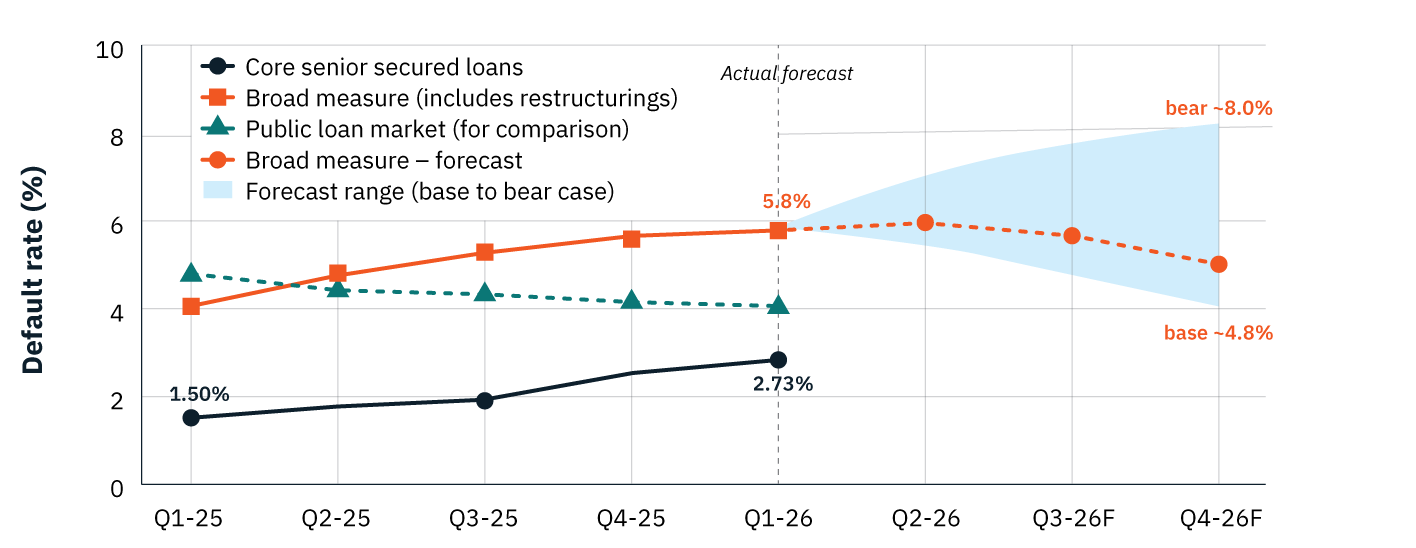
The key point often missed in headline default figures is that a default is not the same as a loss. What matters is the capital lost after recoveries, and on that measure, the data remains reassuring. Senior secured lenders benefit from strong recoveries due to their first claim on assets and ability to intervene early. While the private credit default rate reached 2.73% in Q1 2026, the realised loss rate on direct lending was just 0.70% for full-year 2025 and 0.13% in Q4, both well below the long-run average of 1.01%.
Default rates overstate the risk: actual losses are far lower
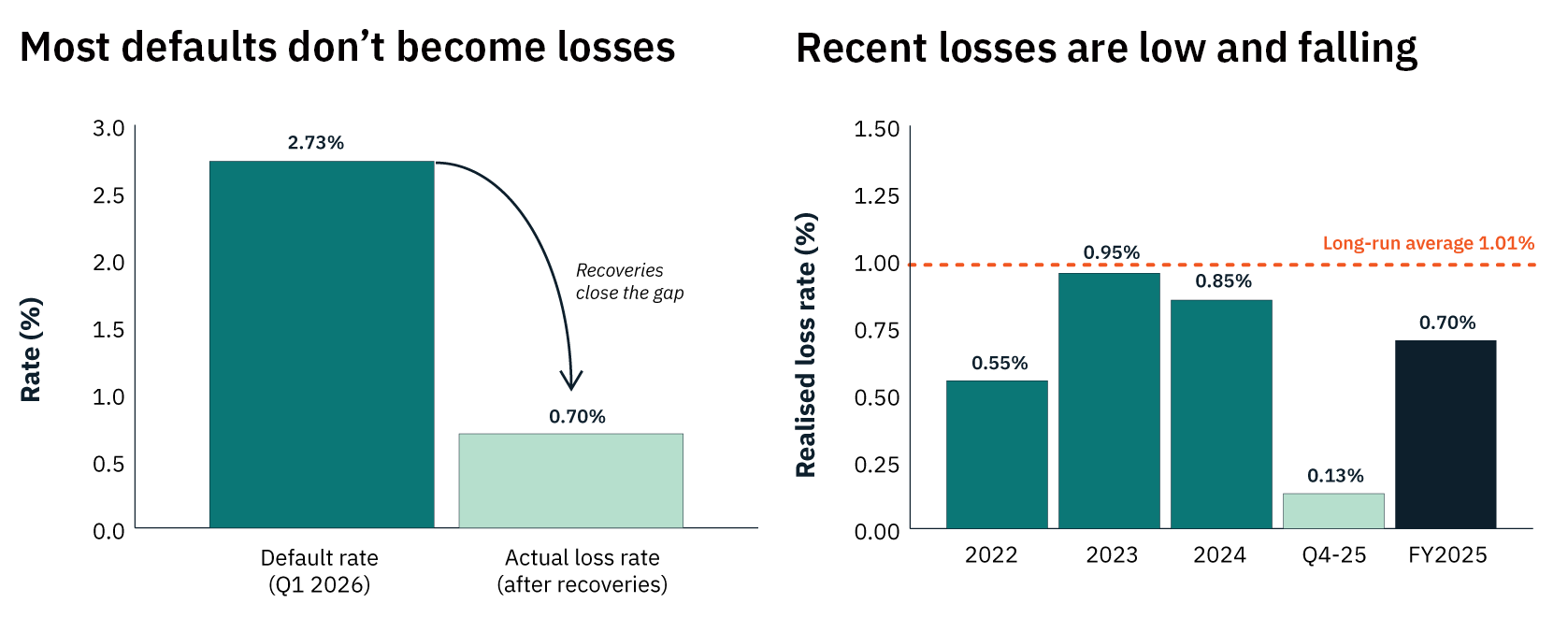
Historical loss experience remains a key differentiator. Over the past five years, senior direct lending (i.e. private credit) has recorded cumulative losses of approximately 1.3%, compared with 3.1% for leveraged loans and 4.2% for high-yield bonds which are publicly traded. This reflects the benefits of senior secured positioning, collateral protection and direct lender engagement, which have consistently helped limit realised losses through market cycles.
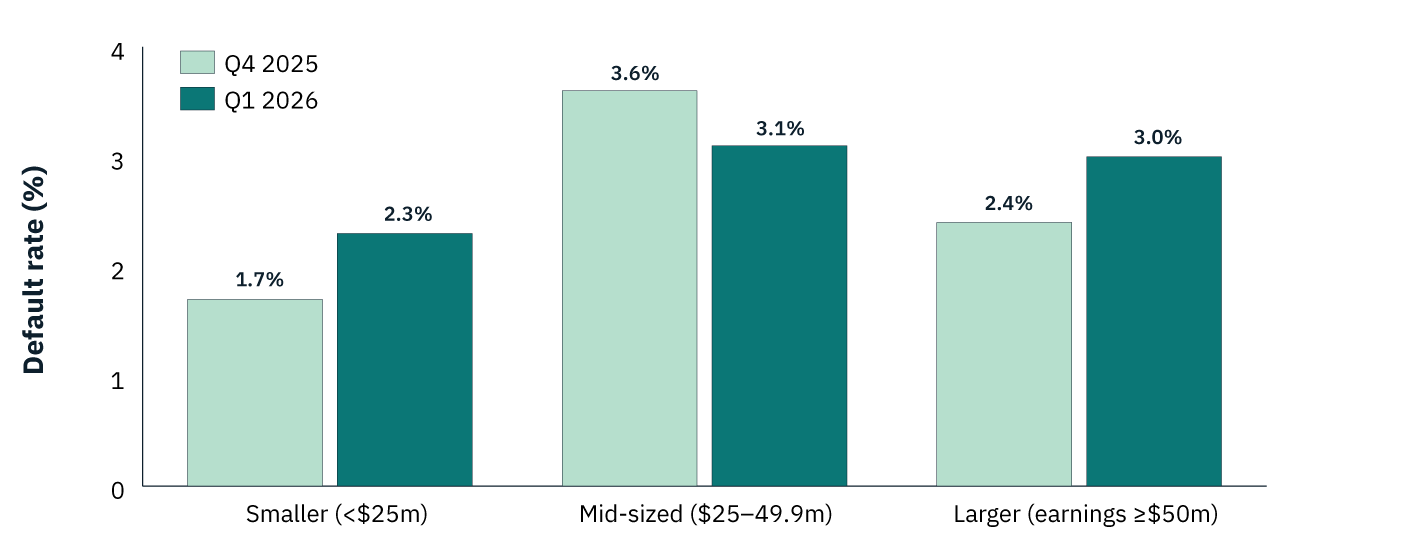
The stress is also selective rather than broad-based: smaller companies saw some increase in defaults during the quarter, mid-sized borrowers improved, and larger borrowers changed modestly. That pattern is inconsistent with a systemic event, reflecting instead a more normal environment where outcomes turn on company fundamentals, sector dynamics and underwriting discipline.
Stress is dispersed, not uniform, across borrower size
Retail investors are driving the narrative
Perhaps the clearest evidence that recent developments are behavioural rather than fundamental lies in investor flows – where the two main investor groups have moved in opposite directions. Retail investors reacted sharply, as AI-disruption concerns and negative media coverage soured sentiment and prompted a wave of redemptions. Institutional investors, insurers and pension funds, by contrast, have largely maintained their commitment, with insurers, in particular, still increasing allocations as they seek attractive income and long-duration assets.
Institutions keep investing as individual investors pull back
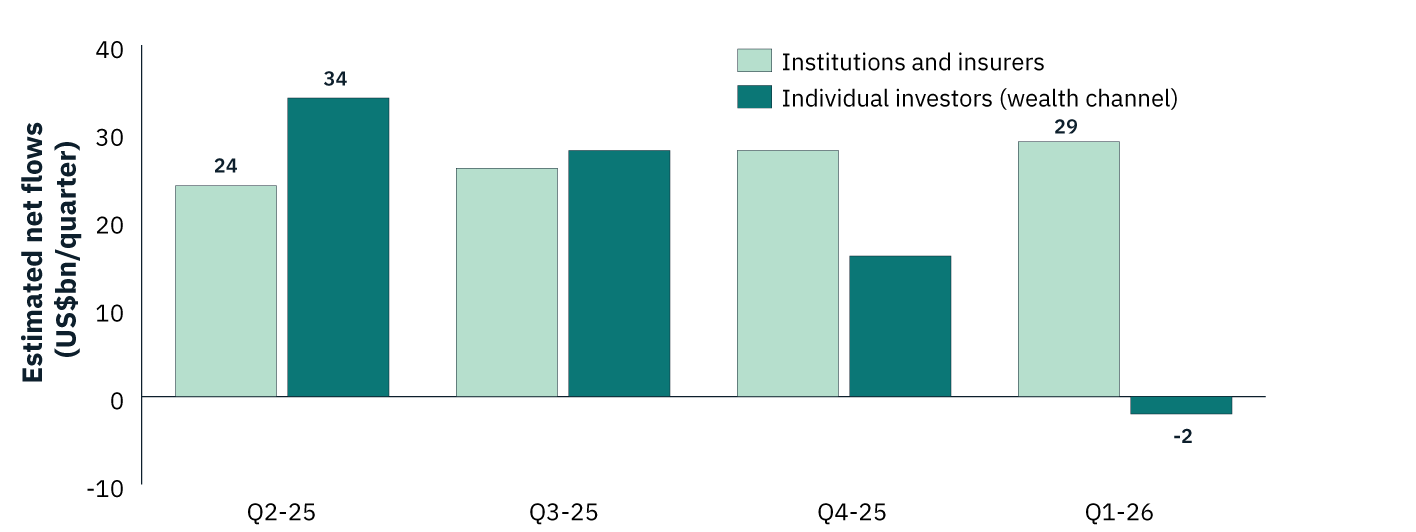
Importantly, rating agencies and market observers have generally attributed these outflows to investor caution rather than a material deterioration in fundamentals, and the redemption mechanisms built into these vehicles are functioning as intended. In several cases institutional investors have been the beneficiaries: long-term capital has increased exposure while retail investors reduced positions, often at more attractive valuations and spreads. This transfer from shorter- to longer-term investors may ultimately strengthen the stability of the sector’s investor base.
Asset-based finance provides diversification
One of the most effective ways to address AI-related concentration concerns is through diversification. Asset-based finance (ABF) has emerged as one of the fastest-growing segments within private credit, offering exposure to pools of contractual cash-flow-generating assets: residential mortgages, consumer loans, equipment finance, receivables and other asset-backed lending, rather than individual corporate borrowers.
Because returns are supported by diversified collateral pools rather than a single company’s performance, these strategies have very different risk characteristics from corporate lending and tend to be less sensitive to the technology and software sectors at the centre of recent attention. For many portfolios, combining corporate direct lending with asset-based finance can improve diversification while maintaining attractive income and downside protection.
Conclusion
While AI will undoubtedly create both winners and losers across parts of the economy, the evidence to date suggests it is reinforcing the importance of disciplined underwriting and portfolio construction rather than fundamentally changing the investment case for private credit. For long-term investors, today’s market may ultimately present a more attractive opportunity, with wider spreads, stronger lender protections and improving relative value.
Sources
- BIS – Private credit’s software lending meets AI disruption (Quarterly Review, Mar 2026)
- Neuberger Berman – Private Credit and BDCs: Why the Sell-Off Tells an Incomplete Story (May 2026)
- Proskauer – Private Credit Default Index, Q1 2026 (Apr 2026)
- Northleaf Capital – Private Credit Market Update Q1-2026
- Morgan Stanley – Alts in Focus: 2026 Private Credit Outlook
- Moody’s – US Corporate Default Risk in 2026 (Apr 2026)
- BofA Global Research / Reuters – US private credit defaults seen easing in 2026
- Bloomberg – Non-traded BDC redemptions exceed fundraising for first time (May 2026)
- PitchBook – BDC redemption requests likely to peak in Q2 2026 (BofA)
- CAIA – Private Credit Redemptions, Defaults, and Wrappers (Apr 2026)
- With Intelligence – Private Credit Outlook 2026
- McKinsey – Global Private Markets Report: Private Credit (2026)
- BlackRock – 2026 Private Markets Outlook (asset-based finance)