

Pitcher of Wealth – Market snapshot September 2026
Market snapshot
Table 1: Major financial data points – month-on-month change
| 31 August 2026 | 31 July 2026 | Change | |
| S&P/ASX 200 Index | 9076 | 8977 | 1.10% |
| S&P 500 Index | 7686 | 7490 | 2.62% |
| Nasdaq 100 Index | 29457 | 28274 | 4.18% |
| RBA cash rate | 4.35% | 4.35% | 0.00% |
| Australia 10-year yield | 5.09% | 4.93% | 0.17% |
| US Treasury 10-year yield | 4.75% | 4.73% | 0.02% |
| AUD/USD exchange rate | 0.7167 | 0.7019 | 2.11% |
Source: Bloomberg
Key economic news
Global
United States
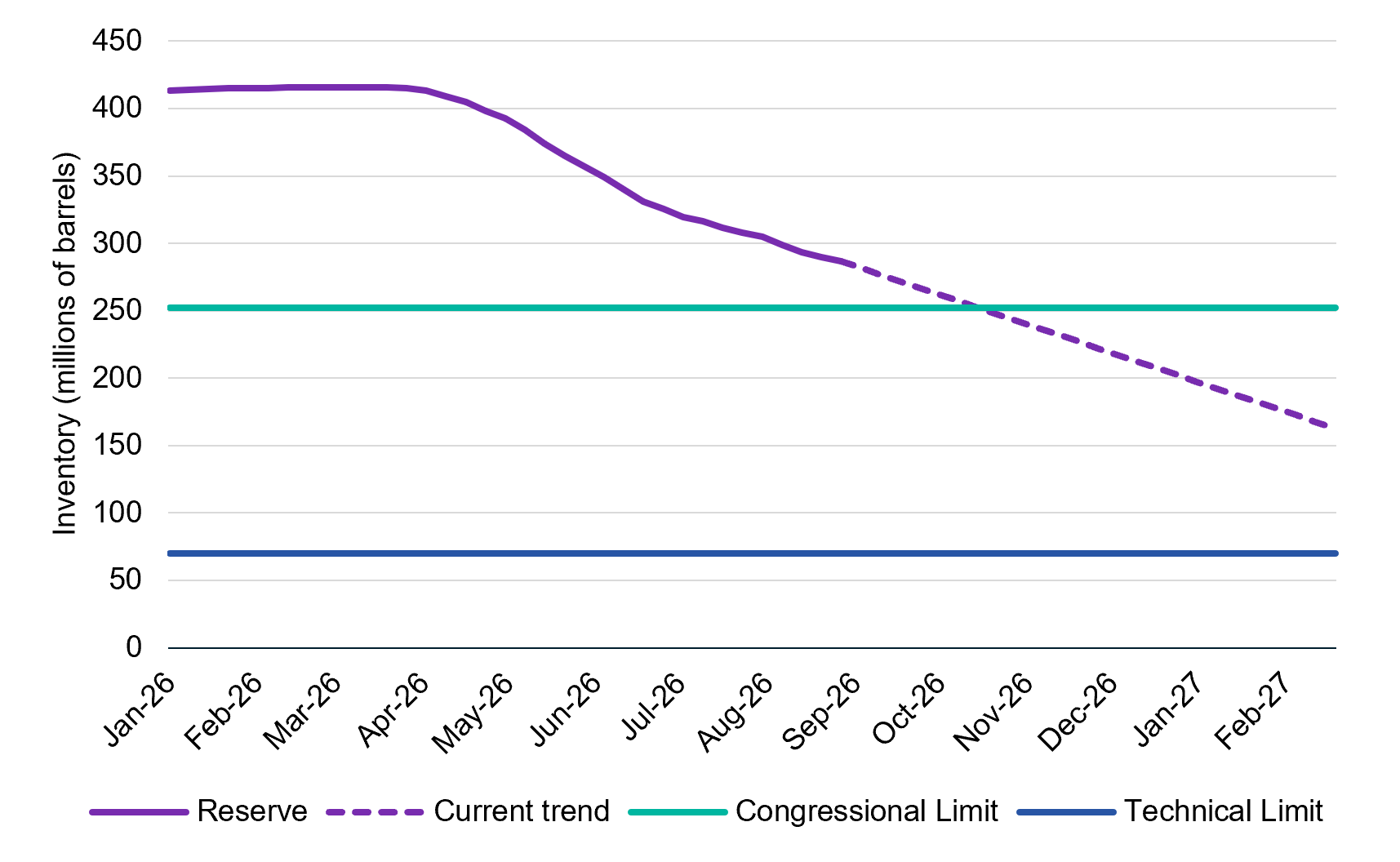
Conflict in the Middle East continues at an intermittent pace with a periodic escalation in attacks and a retaliatory response before subsiding again. President Trump has reiterated that he expects renewed attacks to be short-lived though a resumption of material peace talks appears unlikely at present[1]. Progress will require one or both sides to concede ground. The US for example is continuing to deplete its energy reserves to cap energy prices with the official Congressional limit being reached next month potentially at the current trend. The Congressional limit can be exceeded but technical challenges will begin to complicate further drawdowns. Looming US Congressional elections in November could also pressure the Trump Administration to find a resolution or face a material backlash that would thwart any future policy initiatives.
US strategic petroleum reserve vs depletion trend (Jan-06 to Feb-27)
Source: US Department of Energy, Bloomberg, PPSPW calculations
Meanwhile the blockade of Iranian ports is inflicting sizeable economic damage with inflation around 80% in Iran at present. US forces are escorting tankers through the Gulf presently, easing pressure on the global economy, but this pales when compared against pre-war traffic. The near-term path appears to be a lack of resolution which will continue feeding into inflationary pressures across the world.
Inflation fears have also been a feature for the US. Opaque remarks by Fed Chairman Kevin Warsh regarding his views on inflation targeting had helped feed concerns that the Fed was not looking to act. More recently he has affirmed the Fed’s stance of targeting core PCE inflation of 2%[2] helping somewhat to reassure investor concerns. Another contributing factor has been the expansion of US government spending with the cumulative deficit to July almost US$300bn larger than the equivalent period in 2025.
The last, more prosaic factor is that the US economy is continuing to grow reasonably well with the Atlanta Fed’s GDPNow estimate currently anticipating 4.8% growth for the September quarter[3] on an annualised basis, well-ahead of consensus expectation for 2.5% growth. This figure implies even stronger nominal growth when inflation is considered. An economy growing north of 5% in nominal terms realistically should see bond yields higher commensurate with the stronger mix of both underlying growth and price inflation. This is what we are arguably seeing with yields near these levels before the global financial crisis, the last time we saw nominal economic growth sustained at these rates.
The question now is whether we will see the Fed follow through with higher rates at its upcoming September session. Current consensus forecasts anticipate a holding pattern though market futures appear to be pricing in at least one hike by year-end. In our view it appears the US is set to continue its current trend of high growth and high inflation for the near term at a minimum.
Inflationary pressures remain a bugbear of policymakers in Europe. Euro area inflation accelerated to 3.3% in August, up from 2.9% growth for the year to July largely due to higher energy prices. Core inflation meanwhile subsided to 2.4% over the same period, down from 2.5% growth in July. Market futures are anticipating a further 0.25% hike by the European Central Bank (ECB) at its 10 December meeting to take its key rate to 2.5%.
Eurozone
This news comes as Eurozone manufacturing continues recovering from depressed levels. The S&P Global Eurozone Manufacturing PMI hit 52.7 in August, a 51-month high backed by the strongest growth in new orders since early 2022. The intermediate goods sector including chemicals as well as electrical component production was the biggest contributor to this upswing, suggesting perhaps that the Eurozone may be benefitting from growing technology sector investment spending. Moreover, demand was broad-based with new export business growing for just the second time in almost 5 years. The concern will be whether the ECB may derail the economic bounce back currently underway. Ultimately inflationary pressures remain a concern with the ECB having limited capacity to combat supply-led shocks such as that we are seeing in energy prices. European governments need to continue their investment initiatives to reduce fossil fuel dependence, but this is a longer-term solution by its nature. As it stands growth appears to be improving in the near-term but could be susceptible to a central bank-induced slowdown should the ECB decide to act forcefully in the coming months.
China
In China we continue to see signs of weakness in the domestic economy. Retail sales rose 1.2% for the year to July, shy of the 1.4% growth expected. The lack of government support continues to weigh on household spending. Consumer price inflation is also a telling sign of weakness, rising only 0.8% for the year to July. This is a sharp contrast to the 3.5% producer inflation over the same period indicating businesses are sacrificing margin and, even then, sales growth is hard to come by.
Chinese policymakers appear aware of the challenges with targeted stimulus efforts announced in recent weeks. These include interest rate subsidies for qualifying consumer loans as well as similar support for small business loans[4]. Such measures fall well short of supporting struggling sectors such as the domestic property market where investment continues to fall, down 19.2% for the year to July versus the prior comparison period. While authorities continue to walk a fine line, it is difficult to expect a pickup in growth as exports are the key and only growth engine firing. This will place the government under pressure to attain its 4.5-5% growth target for 2026. As it stands, we expect Chinese growth to continue to be export-led with the economy is aggregate decelerating until household sentiment recovers or meaningful fiscal stimulus is introduced.
Conclusion
The global economy retains notable challenges particularly on the inflation front. Key regions such as the US and Europe appear to be on an improving trajectory while China continues to focus on export sectors with modest tinkering reserved for the domestic economy. Higher interest rates could pose a headwind to the economic uptick underway particularly in Europe and the US but on the whole the global economy remains resilient and continues to weather geopolitical volatility reasonably well.
Australia
Economic growth surprised modestly on the upside for the June quarter. The economy grew 0.4% in the June quarter and 2.1% for the year to June compared to expectations of 0.3% and 1.8% respectively. The surprise on the annual growth front was driven by strength in both private and public sector investment spending with the non-mining sectors growing 14.1% over the year and a more modest 2.4% increase for the public sector. The outlook for investment spending continues to be robust going forward with the latest estimates for FY27 continuing to grow, up 15.5% on the outlook as of March and 14.9% up on the same period for FY26, suggesting meaningful growth in nominal terms.
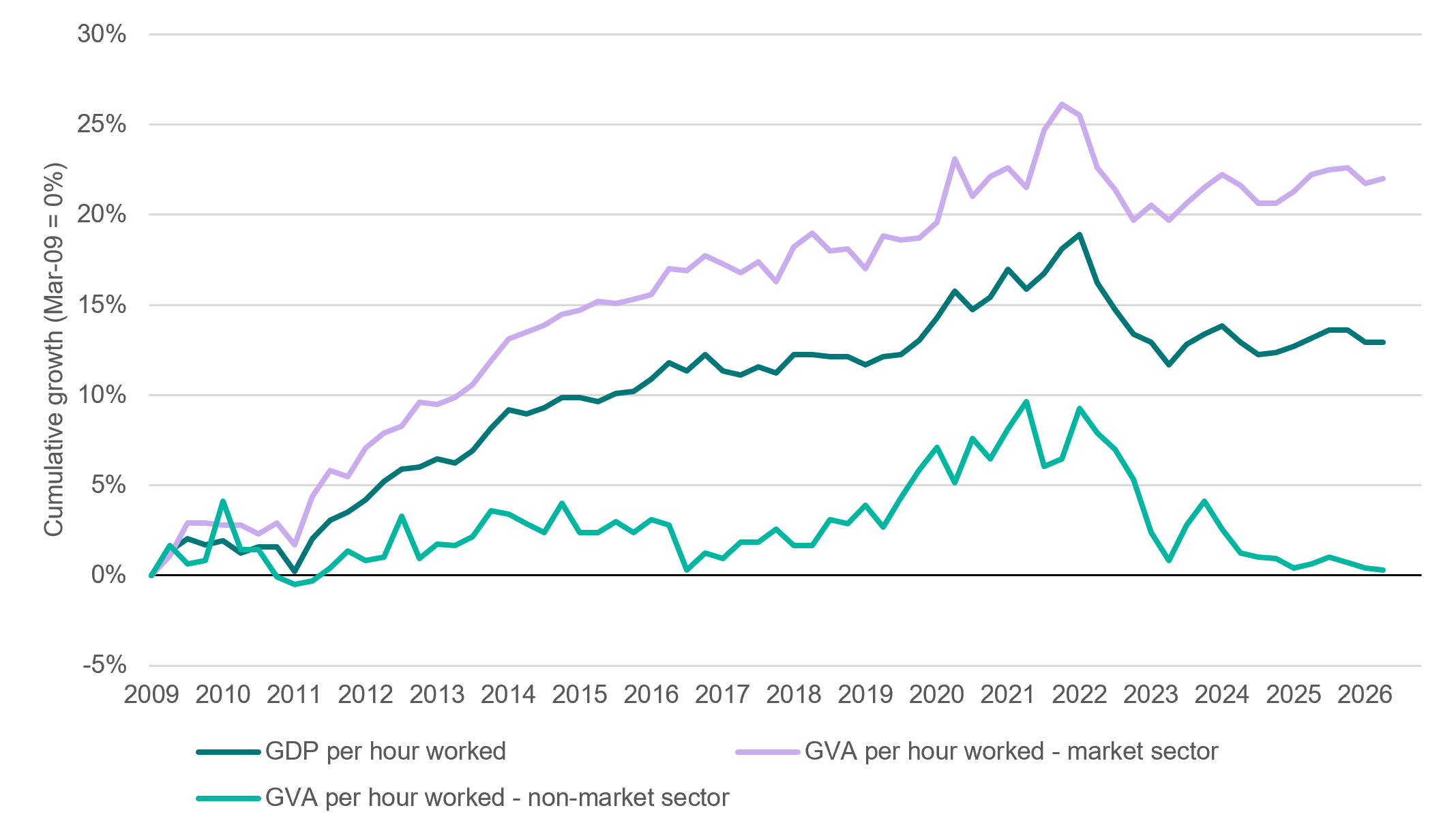
Separately, the productivity challenge, generating more output per unit of input, continues to plague Australia. The concern is that increases in growth will also coincide with higher inflation as we come up against the limited productive capacity of the economy. Stagnation in non-market sectors reliant on government spending (e.g. healthcare, public service) remains an issue with output growth for each hour worked barely positive in recent years. This outcome will add pressure on the Reserve Bank (RBA) to hike interest rates as a curative to higher inflation if the present trend does not reverse.
Productivity growth by sector (Mar-09 to Jun-26)
Source: ABS, PPSPW calculations
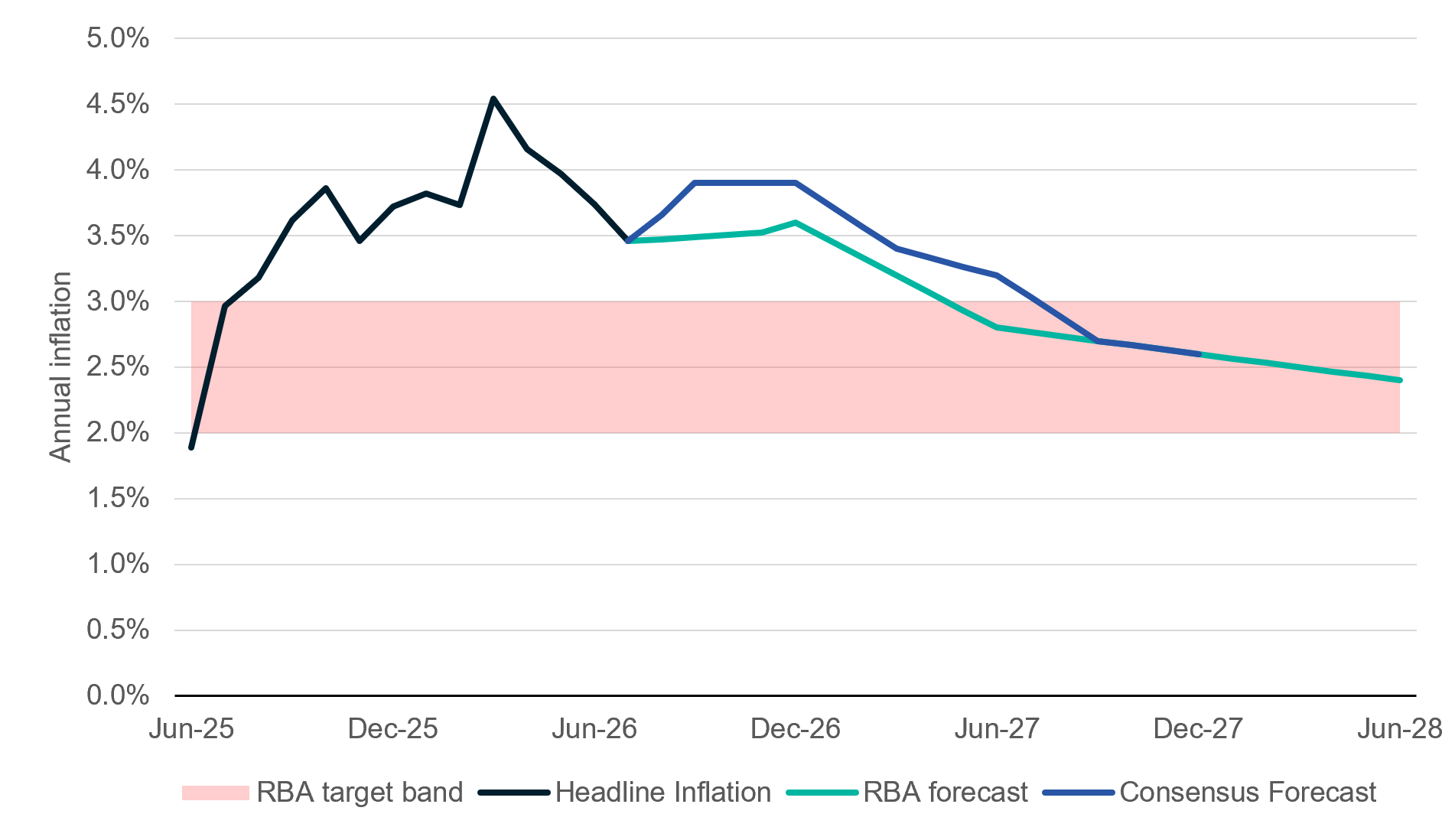
The bigger concern for the RBA remains the inflation backdrop. The latest figures for July showed inflationary pressures surprise on the upside with 3.5% headline growth (3.3% expected) and underlying, trimmed mean inflation holding steady at 3.6%. Both metrics remain persistently ahead of the RBA’s 2-3% target range. The RBA anticipates a meaningful deceleration from December 2026. This may be complicated if their forecasts underestimate inflation. A timelier measure closely correlated to official CPI, the TD Securities-Melbourne Institute Inflation Gauge, showed an inflection higher in August for example. Any meaningful acceleration will likely see the RBA revise their inflation forecasts higher and prompt a return to hiking interest rates. The minutes for their August meeting highlighted this concern with several board members advocating for hikes before ultimately deciding to hold.
Headline inflation versus forecasts (Jun-25 to Jun-28)
Source: ABS, Bloomberg, RBA, PPSPW calculations
The RBA may be inclined to rely on its second mandate, promoting full employment, to keep interest rates steady. The labour market is offering support for this notion with the unemployment rate rising modestly by 0.2% over the year to July and the underemployment rate (people working fewer hours than they would prefer) up a notable 0.8% over the same period. This must be weighed against signs of strong demand in certain sectors. Health care, broadly speaking, continues to see job vacancies track well above pre-pandemic levels. The NAB Business Survey also shows capacity utilisation, a measure of how much businesses are using their existing productive capacity, has bounced back to levels above its 10-year median. This reflects reasonable demand for labour and has historically coincided with stronger demand for labour and higher inflation. A final factor that may stay the RBA is fears of a negative wealth effect from falling house prices. Earlier RBA research suggests a 10% decline in house prices can drive a 1.5% fall in household consumption over time[5]. Falling household spending can have negative implications for growth and the labour market and early signs of decelerating credit growth may portend further (and broader) economic weakness.
The Australian economy, in aggregate, remains resilient. Strong population growth continues to be key with 1.4% growth for the year to June underpinning a still enviable 2.1% expansion in the broader economy. Below the surface, however, is where problems persist, particularly inflation. Productivity remains challenged with limited signs of improvement while underlying inflationary pressures are holding well above target levels. This mix is likely to pressure the RBA to follow through on interest rate hikes with few signs of economic weakness sufficiently evident to stay their hand though an emerging negative wealth effect could also play a role allowing the Board to wait and determine its near-term impact.
[1] ‘Trump says Iran Strikes to Be Short, Asserts Hormuz Control’, Bloomberg News (3 September 2026), Trump Says Iran Strikes to Be Short, Asserts Hormuz Control – Bloomberg, (accessed 4 September 2026).
[2] T. Lauricella, ‘Warsh sounds hawkish, but will there be a September US rate hike?’, Morningstar (31 August 2026),Warsh sounds hawkish, but will there be a September US rate hike?, (accessed 1 September 2026).
[3] ‘GDPNow’, Federal Reserve Bank of Atlanta (1 September 2026), GDPNow – Federal Reserve Bank of Atlanta, (accessed 2 September 2026).
[4] E. Ma, ‘China unveils targeted measures to aid slowing economy amid louder calls for policy support’, South China Morning Post (21 August 2026), China unveils targeted measures to aid slowing economy amid louder calls for policy support | South China Morning Post, (accessed 22 August 2026).
[5] G. Debelle, ‘Housing and the Economy’, Reserve Bank of Australia (17 October 2019), Housing and the Economy | Speeches | RBA, (accessed 4 September 2026).