
Pitcher of Wealth – Market snapshot October 2026
Market snapshot
Table 1: Major financial data points – month-on-month change
| 31 October 2026 | 31 September 2026 | Change | |
| S&P/ASX 200 Index | 8908 | 8789 | +1.35% |
| S&P 500 Index | 7580 | 7652 | -0.93% |
| Nasdaq 100 Index | 28385 | 30409 | -6.65% |
| RBA cash rate | 4.60% | 4.60% | +0.00% |
| Australia 10-year yield | 5.12% | 5.35% | -0.23% |
| US Treasury 10-year yield | 4.93% | 5.28% | -0.36% |
| AUD/USD exchange rate | 0.7032 | 0.6947 | +1.22% |
Source: Bloomberg; note that the RBA cash rate was increased to 4.85% on 3 November 2026
Key economic news
Global
The US mid-term elections have been the defining moment in recent weeks. The Republican Party lost its majority in both the House and Senate to the Democrats with the latter also winning a majority of the State governor contests. Ostensibly “safe” Republican States flipped in a meaningful fashion with Gina Hinojosa for example becoming the first Democrat Governor of Texas in 35 years.
US Senate: Change in Senate vote share from the 2024 presidential results by county
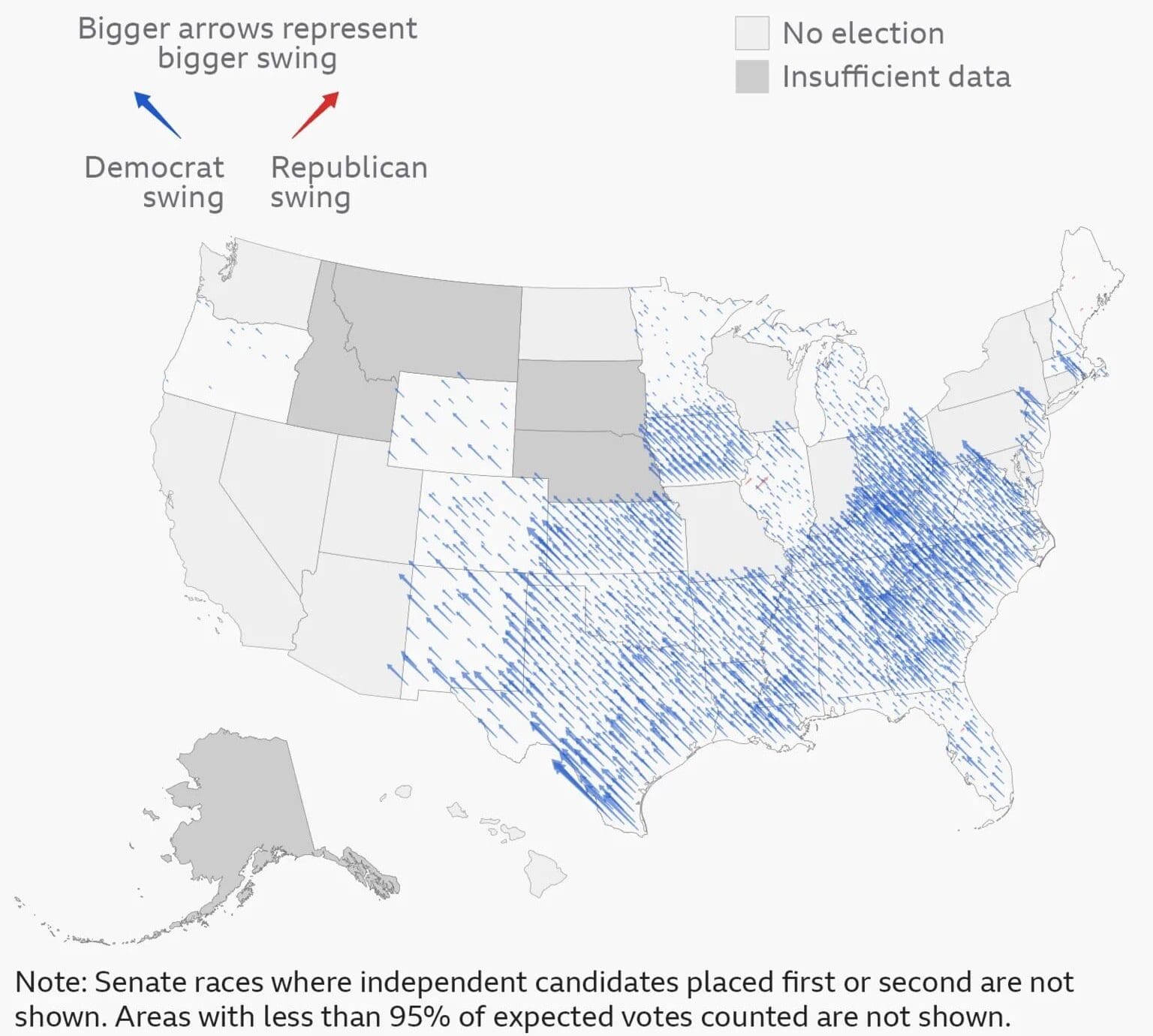
Source: BBC[1]
The US is set to enjoy another “lame duck” presidency where opposing parties control the Legislature and the Executive hamstringing the possibility of new legislation as President Trump can veto proposed bills as he chooses. Conversely, Congress can limit the President’s ability to wage war or prosecute other goals by restricting funding as well as be a material distraction by investigating the conduct of members of his Administration for alleged corruption and other misconduct.
Economically speaking it is premature in our view to determine how much will change in the near term. President Trump still controls the Executive branch of government including federal agencies. He has also shown a willingness to use these capabilities. While he has lost access to lawmaking power via Congress his Administration was not one set on an ambitious legislative agenda. Investors are speculating sizeably about the possible hamstringing of data centre construction and its consequences for end-demand of semiconductors and other associated equipment. While a Democrat Congress could pass restrictive legislation it is unlikely to become law due to the Presidential veto power. Democrat governors could exert influence on a state-by-state basis to limit construction but that will also be limited in our view due to the potential economic cost in terms of lost jobs and taxation revenue.
Lastly, on the foreign policy front there has been sizeable expectation that a Democrat Congress could push the Trump Administration towards peace with Iran with the President suggesting negotiations hold promise as well though given material differences in desired outcomes (e.g. Iran wanting US withdrawal from the region) this may take time to eventuate and the long list of false dawns of “possible” peace deals since the conflict began serve as further caution in our view.
Moving from politics to the economic state of play, the US currently enjoys a mix of both robust growth and its own inflation challenges. Underlying inflation as measured by the Core PCE Index rose 3.1% for the year to September[2]. This metric excludes both food and energy costs and highlights the broad-based nature of rising prices within the US. There at least, however, we are seeing more sizeable growth as an offset with GDP expanding 3.4% on an annualised basis in the September quarter versus expectations for 3.2% growth[3]. The US consumer despite Federal Reserve rate hikes has remained resilient with household spending growing 3.8% over the same period (3.4% expected).
We anticipate the US to continue expanding at a stronger rate than developed peers in the near term with a growth dividend from the sizeable pipeline of AI-related investment already underway. Said pipeline does pose a risk to growth if thwarted, but we need to see more tangible evidence before calling out a more pessimistic outlook.
China continues to track the same path of export ambitions and domestic malaise. At a headline level this focus does not seem to be hurting the level of economic activity. The economy grew 4.5% in the September quarter (4.4% expected) with the economy expanding 4.6% for the first nine months of 2026 in line with the government’s target range of 4.5%-5%[4]. Net exports accounted for 40% of the overall GDP expansion for the quarter, the most since the start of 2025[5]. There are concerns over the fragility of this dependence however with the latest Manufacturing PMI survey flagging a 3-month low in new export orders[6]. This implies that growth may slow once the current backlog is fulfilled.
On the domestic front we did see a positive surprise in retail sales expanding 1.1% for the year to September (0.5% expected) though this must be weighed against continued weakness in the property market where investment slipped 20.6% for the first nine months of 2026[7]. While the retail sales bounce is encouraging it remains weak relative to other sectors of the economy with more needed to support domestic demand. On this front we have seen additional stimulus announcements including an additional US$82bn to support local governments[8]. While acknowledgement of the issue is encouraging, more decisive intervention remains elusive and we expect China to continue leaning on the export channel to support growth though even this is facing challenges. A landmark deal with the EU to halve hybrid exports to the bloc[9] highlights a growing pushback against Chinese efforts to export surplus productive capacity and could see growth continue to decelerate in the months ahead if other regions follow suit.
Finally in the Eurozone we saw another surprise with stronger-than-expected economic growth. GDP for the bloc expanded 0.4% for the September quarter and 1.3% for the year to September ahead of expectations for 0.2% and 1.3% growth respectively. Business surveys have remained positive despite the region’s challenges as an energy importer amidst ongoing conflict in the Middle East. These surveys are slowing however with October Composite PMI hitting a 4-month low [10] suggesting growth remains at risk and likely to slow in the near term. A lasting peace deal in the Middle East would offer substantial relief in the near term should it eventuate with businesses raising inflation as one of their biggest concerns at present.
Headline inflation continues to be elevated at 3.8% for the year to September with core inflation up a more modest 2.5% over the same period. Producer inflation to echo the survey comments was up 11.1% for the year to September foreshadowing looming inflation pressures as businesses pass on these costs. The ECB is expected to hike at least once more in 2026 and it is facing an unenviable choice between supporting weaker growth or containing inflation through higher rates. We expect the bloc to continue expanding albeit at a slower rate with political tensions potentially seeing meaningful change in government over the coming months as the citizenry reacts to growing cost-of-living concerns.
The US election outcomes offer a potential reset in many ways from the extremes of the Trump administration, but these will be moderated by the reality that the President remains in office and still exerts Executive power. Inflation is a universal problem but especially for energy importers such as the Eurozone with policymakers, for now, willing to trade growth for the prospect of containing inflation expectations. Meanwhile China continues to tinker with its own economic balance without substantive changes although the trade deal with the EU may hint at further compromises to come. On the whole, economic activity was stronger than expected for the September quarter and we should see further expansion into year-end albeit at a slower rate with regional dispersion growing. A peace deal in the Middle East would offer a meaningful tailwind to the global economy but it remains to be seen whether hinted talks bear fruit.
Australia
The RBA decision to raise its cash rate to 4.85% in early November looms large on the economic outlook. This decision followed another inflation surprise in the latest September quarter data. Inflationary pressures are broad-based with the surprise driven by higher pricing in new housing, rising electricity costs with elevated energy prices from the Middle Eastern conflict only part of the larger quandary. Governor Bullock was at pains to emphasise the domestic nature of the inflation challenges with productivity improvement sorely needed to contain these impulses.
At the same time, however, the RBA Board reduced its hawkish bias in its November statement. It no longer appears on the brink of hiking given the lack of “standing ready” to act on inflation. We anticipate the Bank will remain in a holding pattern for December and will be content to wait to February to monitor developments in inflation data before considering further hikes. Upside inflation surprises remain a live risk with the RBA’s latest forecasts for headline inflation anticipating a smoother deceleration than consensus. Its view on underlying inflation is similar and flies in the face of recent data which has remained stubbornly above the 2-3% target range even with energy costs being excluded. This raises the risk that the Board hikes further to adequately slow down the economy and curb inflationary pressures if current forecasts prove inaccurate.
Inflation forecasts – RBA vs Economist consensus (Sep-26 to Mar-28)
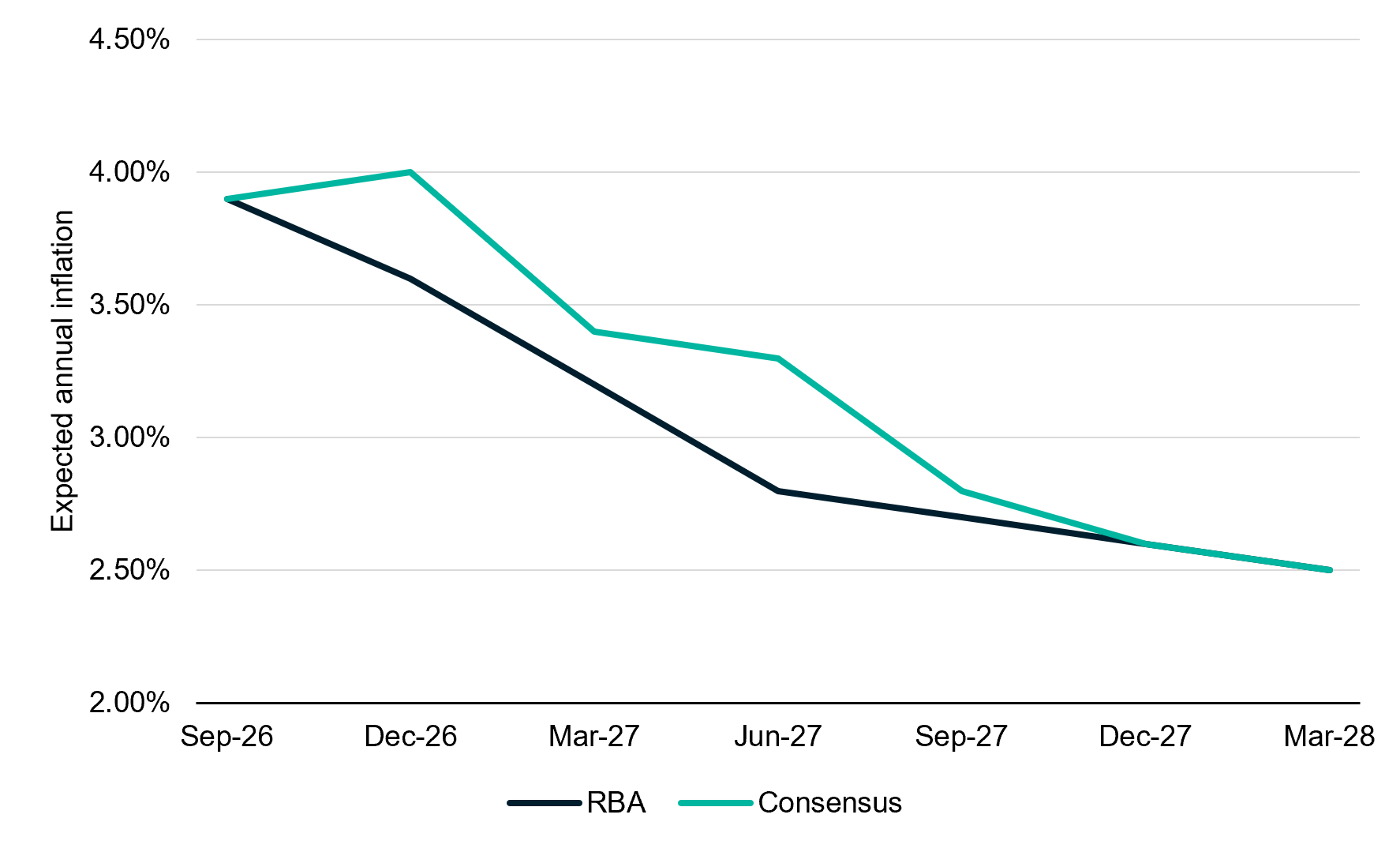
Source: RBA, Bloomberg
The reality of excessive demand relative to the economy’s productive capacity is becoming better understood. There are increased calls for reducing the public sector’s economic involvement though the pace of spending growth in areas such as health care or defence suggest this may prove difficult to curtail. In addition, our version of the data centre construction boom is posing near-term challenges as it competes for resources with other sectors including heightening infrastructure spending. This combination could further complicate the RBA’s efforts as interest rates are less impactful here.
Value of projects under construction ($b)
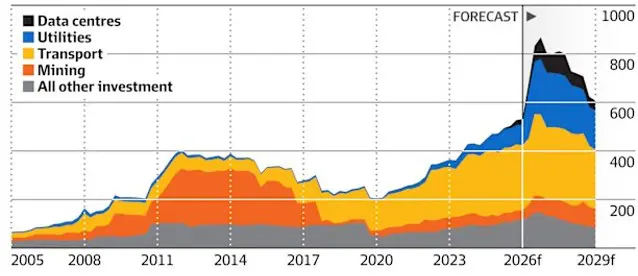
Source: Deloitte Access Economics[11]
There are offsets available to the RBA. The housing market downturn is expected to drag on consumer spending which should be a headwind to the broad economy and weaken inflationary pressures. This is consistent with the RBA and consensus economist forecasts anticipating below-trend growth out to 2028 along with unemployment above 5%. Lastly, the potential for peace in the Middle East could give the RBA time to wait before acting as a correction to energy prices would slowdown headline inflation substantially.
We expect the Board to remain focused on data releases and in a holding pattern for the near term until the Board can assess that inflation has remained elevated or this year’s hikes have had a sufficient impact in cooling price growth.
In terms of the broader economic assessment, the labour market has loosened somewhat in 2026. The unemployment rate is 4.7% as of September, up 0.6% from its December 2025 level. The underemployment rate measuring people with capacity to work more hours than they currently do has also climbed from 5.7% to 6.3% over the same period. Both remain reasonably below pre-pandemic levels suggesting that while this news is a concern it will not yet loom large in the RBA’s decision making. Furthermore, household spending has remained remarkably resilient, rising 6.8% in nominal terms for the year to September (3.2% in volume terms). While this has been inflated in part by elevated fuel costs the reality remains that households have been able to continue spending at a strong rate which continues to underpin overall economic activity.
The Australian economy has an inflation challenge. The concern is that this could see inflation expectations become unmoored with households and businesses adjusting their behaviour to a higher inflation environment with flow-on consequences for entrenching higher inflation and economic volatility. We expect this to remain the near-term focus for policy makers with reasonable health in household spending and the labour giving them licence to slow down the broader economy through rate hikes and, possibly, a pullback in government spending.
[1] ‘How America votes in maps and charts’, BBC News (12 November 2026), Story of US 2026 midterm elections in maps and charts, (accessed 11 November 2026).
[2] F. Craig, ‘US PCE Inflation Rises to 3.6% in September, Matching Economists’ Forecasts’, yahoo!finance (30 October 2026), U.S. PCE Inflation Rises to 3.6% in September, Matching Economists’ Forecasts, (accessed 1 November 2026).
[3] M. Zahn, ‘US economy grew more than expected in 3rd quarter, government data shows’, ABC News (29 October 2026), US economy grew more than expected in 3rd quarter, government data shows – ABC News, (accessed 4 November 2026).
[4] ‘China’s stronger-than-expected GDP growth sends positive signal’, South China Morning Post (21 October 2026), Editorial | China’s stronger-than-expected GDP growth sends positive signal | South China Morning Post, (accessed 28 October 2026).
[5] ‘China’s Economy Dealt Surprise Setbacks in Risk to Growth Pillar’, Bloomberg (2 November 2026), China’s Economy Dealt Surprise Setbacks in Risk to Growth Pillar – Bloomberg, (accessed 4 November 2026).
[6] ‘RatingDog China General Manufacturing PMI’, RatingDog (2 November 2026), RatingDog China General Manufacturing PMI, (accessed 4 November 2026).
[7] R. Nair, ‘China industrial output, retail sales beat expectations in September’, yahoo!finance (19 October 2026), China industrial output, retail sales beat forecasts in September, (accessed 22 October 2026).
[8] S. Tze Wei, ‘China’s growth dilemma: More stimulus, but where is the demand?’, ThinkChina (19 October 2026), China’s growth dilemma: More stimulus, but where is the demand? | ThinkChina, (accessed 23 October 2026).
[9] L. O’Carroll, ‘China agrees to ‘halve’ hybrid car exports to EU in landmark deal’, The Guardian (9 October 2026), China agrees to ‘halve’ hybrid car exports to EU in landmark deal | Automotive industry | The Guardian, (accessed 24 October 2026).
[10] ‘S&P Global Eurozone Composite PMI’, S&P Global (4 November 2026), S&P Global Eurozone Composite PMI, (accessed 5 November 2026).
[11] M.Read, ‘Mega construction Boom stirs RBA rate worries’, Australian Financial Review (4 November 2026), afr.com/policy/economy/mega-construction-boom-stirs-rba-rate-worries-20261104-p61b7r, (accessed 5 November 2026).