

Pitcher of Wealth – Economic update August 2026
Market snapshot
Table 1: Major financial data points – month-on-month change
| 31 July 2026 | 30 June 2026 | change | |
| S&P/ASX 200 Index | 8977 | 8779 | 2.26% |
| S&P 500 Index | 7490 | 7499 | -0.13% |
| Nasdaq 100 Index | 28274 | 30276 | -6.61% |
| RBA cash rate | 4.35% | 4.35% | 0.00% |
| Australia 10-year yield | 4.93% | 4.72% | 0.21% |
| US Treasury 10-year yield | 4.73% | 4.47% | 0.27% |
| AUD/USD exchange rate | 0.7019 | 0.6919 | 1.45% |
Source: Bloomberg
Key economic news
Global
The conflict between Iran and the US resurged in July with President Trump effectively declaring the ceasefire over just three weeks after it began. The sticking point appeared to be Iranian efforts to enforce its control over the Strait of Hormuz with attacks on shipping triggering a forceful US response. In the past week hopes are rising that a decisive agreement might be underway following the pause of US attacks over the weekend. There are initial reports that an interim deal might be announced later this week that a 60-day agreement on Hormuz shipping could be announced with no tolls being charged and, both Iran and Oman working together to clear mines in the Strait[1]. Subsequently we have seen an effective stalemate emerge with both the US and Iran limiting traffic through the Strait with negligible progress towards a resolution . In the meantime, we have seen global supply chains work to realign away from the Strait and secure alternate sources of key resources. These include Saudi Arabia’s pipeline to the Red Sea as well as an emerging “dark” trade where shipments are still passing through the Strait while hiding their presence and being subjected to intermittent Iranian attacks [2]. These changes have blunted the impact of the Strait’s closure as has the release of strategic oil reserves into global energy markets.
The challenges from the Middle East have posed unwelcome challenges on the inflation front globally. In the US the Federal Reserve’s preferred measure, the Core PCE price index tracks the spending habits of domestic households and strips out more volatile food and energy costs. This has risen 3.3% for the year to June, uncomfortably above the Fed’s long-term 2% target. These pressures have added to the case for rate hikes. In the Fed’s July meeting the majority voted in favour of keeping interest rates on hold with three dissenting in favour of a hike. There are some signs of inflation softening with wage growth slowing and jobs growth disappointing expectations in recent months. The latest job vacancy data also missed estimates with 7.359 million in June (consensus 7.44 million), declining by 0.178 million from May’s revised result. Taken together the Fed’s holding bias appears set to continue unless we see an acceleration in inflationary pressures with sufficient weakness in the jobs market helping justify a holding pattern at present.
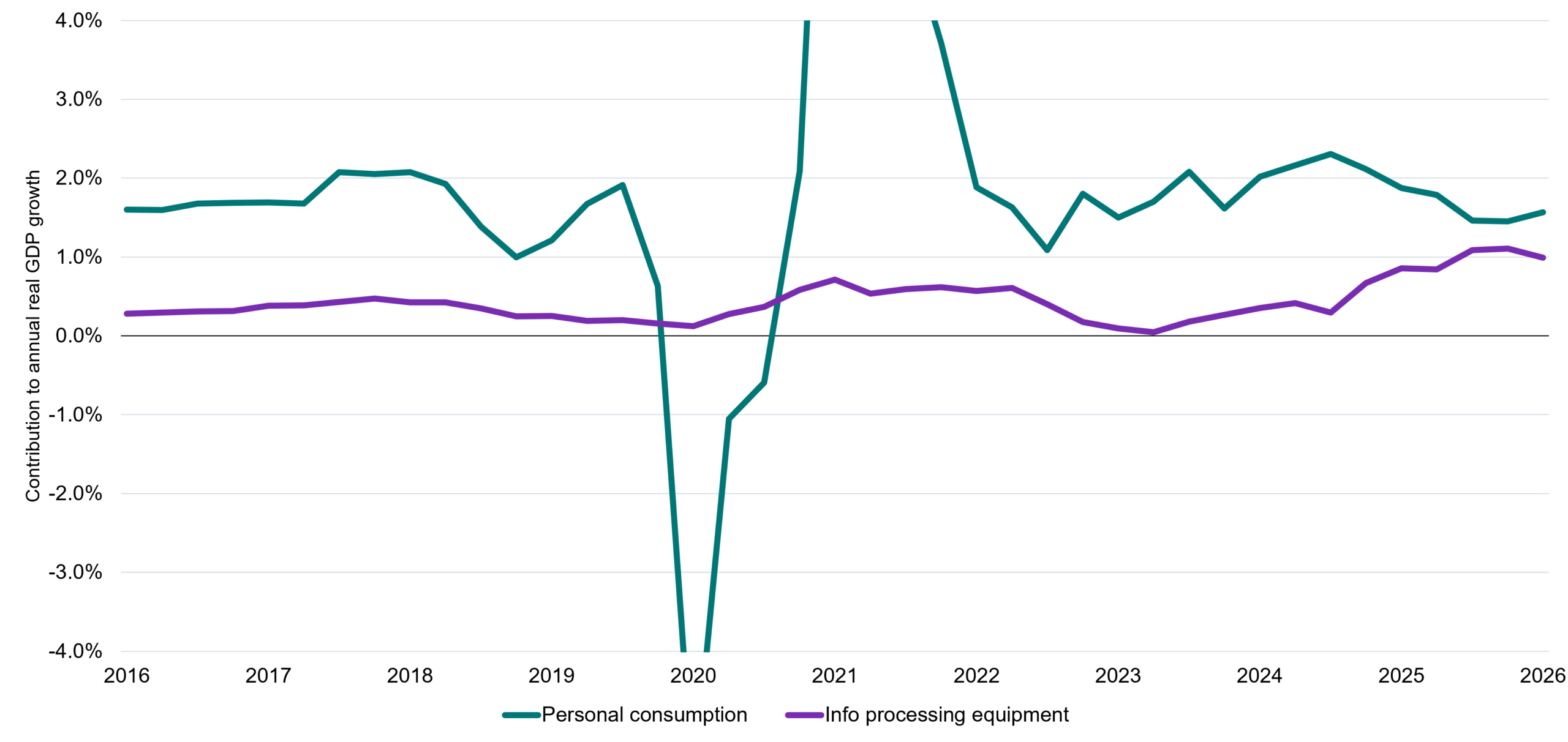
The US economy grew 2.1% for the year to June, marking a deceleration from the March quarter. A widening trade deficit saw net exports continue to drag on the economy whilst higher fuel prices also posed a notable headwind. On the flipside however is the growing impact of investment in artificial intelligence (AI) infrastructure, which is contributing meaningfully to growth, 1% in the June quarter. This contrasts to the (still) larger contribution from household spending (1.6%) a key driver of the US economy in aggregate. The noteworthy feature here is that whilst the AI infrastructure buildout is seeing leakage in the form of heightened imports of semiconductor chips for instance it is still creating a large mix of direct and indirect tailwinds to economic growth.
Annual contribution to US GDP growth (Jun-16 to Jun-26)
Source: BEA, Bloomberg, PPSPW calculations
Meanwhile in Europe we saw the region surprise positively for the June quarter with growth ahead of expectations at 0.4% for the quarter (consensus: 0.2%) and 1% for the year to June. Growth was mixed across the region with Ireland contributing an outsized 3.9% thanks to its role as a tax haven for multinationals which introduces volatility in its economic results while core Bloc countries in France, Germany and Italy saw a more modest 0.2% expansion. Spain was a surprise outperformer at 0.7%. This overall result is encouraging given the challenges posed by higher energy prices and weaker household confidence.
Looking ahead the July Markit PMI for the Eurozone marked a positive start to the current quarter. The Composite PMI reached an 8-month high of 52, signalling expansion across both manufacturing and services sector and an acceleration of economic growth to 0.3%. July is the first month showing a significant increase in services sector activity since the Middle East conflict began and coincided with stronger business confidence as well.
On the downside, however, we saw Eurozone inflation tick higher with a 2.9% increase for the year to July, impacted heavily by the surge in energy prices after the Iranian conflict began. Underlying inflation, stripping out food and energy costs, likewise accelerated to 2.5% over the same period with services costs a major feature, up 3.3%. This may see the ECB act again in hiking rates to follow on from its June decision with another inflation print ahead of its next meeting. In summary the Bloc looks to have navigated this period better than the challenges posed by the Russian invasion of Ukraine in 2022 and appears set for modest growth in the second half of the year especially if we see decisive resolution of the Iranian conflict.
Finally in China we saw a surprising degree of weakness in the June quarter with growth for the year to June of 4.3%, below the government’s annual target range of 4.5%-5% and consensus forecasts for 4.5% growth. This comes as the country’s export performance continues to hold up well with 27% growth for the year to June, bolstered by demand for semiconductor and electric vehicle exports. Domestically, however there remain challenges with retail sales rising only 1% over the same period pointing towards weak household consumption. There continues to be a meaningful disconnect between the prices consumers pay with headline consumer inflation at only 1% versus those being borne by Chinese businesses with producer price inflation of 4.1%. This suggests limited scope for Chinese businesses to raise prices given weak domestic demand conditions and offers another reason behind the country’s drive to grow exports.
The relative weakness in household spending might, finally, be drawing the attention of authorities. The State Council in mid-July approved a new five-year plan to expand consumption targeting 60 trillion yuan (US$8.3 trillion) in retail sales of consumer goods by 2030 in a bid to rebalance the economy to more domestic demand-led growth[3]. This would imply 3.7% p.a. growth from 2025’s 50.1 trillion yuan result and marks an ambitious target given the sector’s current malaise. Notable targets for improvement include bolstering the country’s service sector including tourism as well as lifting wages and expanding the social safety net to encourage household spending. If we see meaningful action along these lines, it could do much to address the imbalances of excess production that have marred China’s economy in recent years.
These policy moves come at an opportune time. The latest Markit PMI survey for the country flagged a notable moderation in services sector growth in July and similarly for the manufacturing sector with the overall Composite PMI slipping to its weakest level in a year with weaker domestic demand a feature particularly for the services sector. In summary, the Chinese economy appears to be going through a spell of weaker performance in line with the gradual decline in headline growth over recent years. Domestic imbalances, particularly excess production relative to what domestic demand can absorb, appear to be attracting more forceful policymaker attention. The country’s technological edge in key sectors such as electric vehicles and advanced manufacturing remain undisputed and the question will be how successful it can reform the economy in the coming years to rebalance growth to a more sustainable, domestic-led posture.
Australia
July was marked by a range of key economic datapoints that will pose serious questions of the Reserve Bank in its upcoming 10-11 August meeting. Current consensus forecasts by market economists favours a holding pattern followed by rate cuts in 2028 whilst market-implied pricing suggests scope for at least one potential hike by year-end.
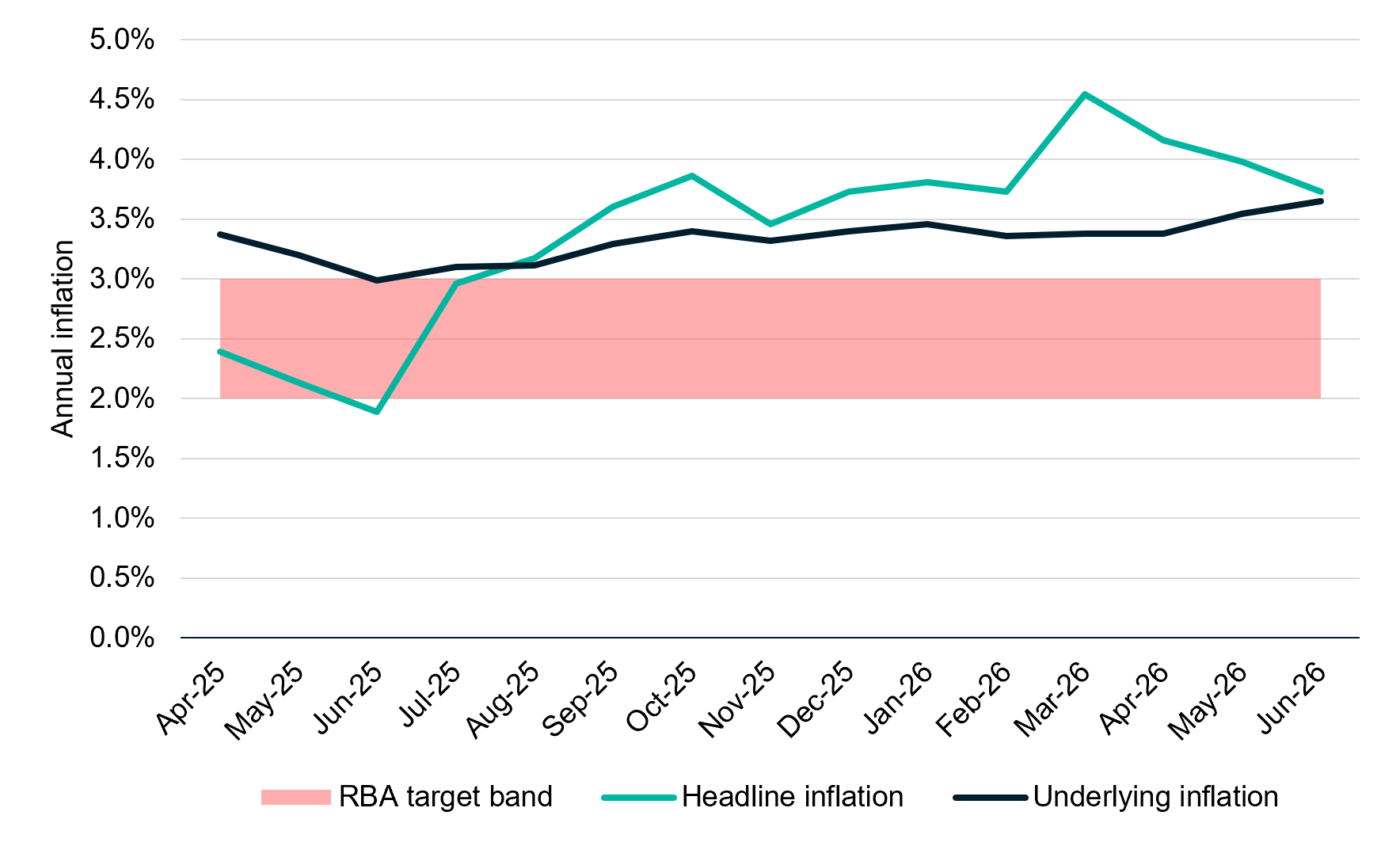
On the inflation front June saw headline inflation decelerate to 3.8%, down from 4% for the twelve months to May. A 2.7% drop in transport costs, impacted by both the fuel excise cut and decline in energy prices in June, contributed sizeably to the move. The average of the less volatile trimmed mean and weighted median measures saw underlying inflation hold steady at 3.6%. This is well above the RBA’s target band of 2-3% and has persisted at these levels for over a year now casting doubt on the Board’s ability to achieve price stability.
Headline versus underlying inflation (Apr-25 to Jun-26)
Source: ABS, PPSPW calculations
The other leg of the RBA’s mandate is to promote full employment, the level of unemployment that generates steady inflation outcomes. On this front the labour market has remained unquestionably tight with unemployment at 4.4% in June and broader underemployment at 6.5%. Vacancies continue to track at reasonable levels albeit slightly softening over the past year. The main points of weakness lie in Victoria where the unemployment rate sits at 5.1%, well above the national average and in labour outcomes for 15–19 year-olds whose underutilisation rate (unemployment plus underemployment) sits at 37.2%. This cohort tends to see the most labour market flexibility given alternative options in school and university. Their underutilisation rate bottomed at 28.3% in June 2022 so an almost 9% upswing is suggesting slack in the jobs market is emerging. We believe the RBA will not be preoccupied by the jobs market in its upcoming August meeting as there are insufficient signs of sizeable loosening to stay its hand.
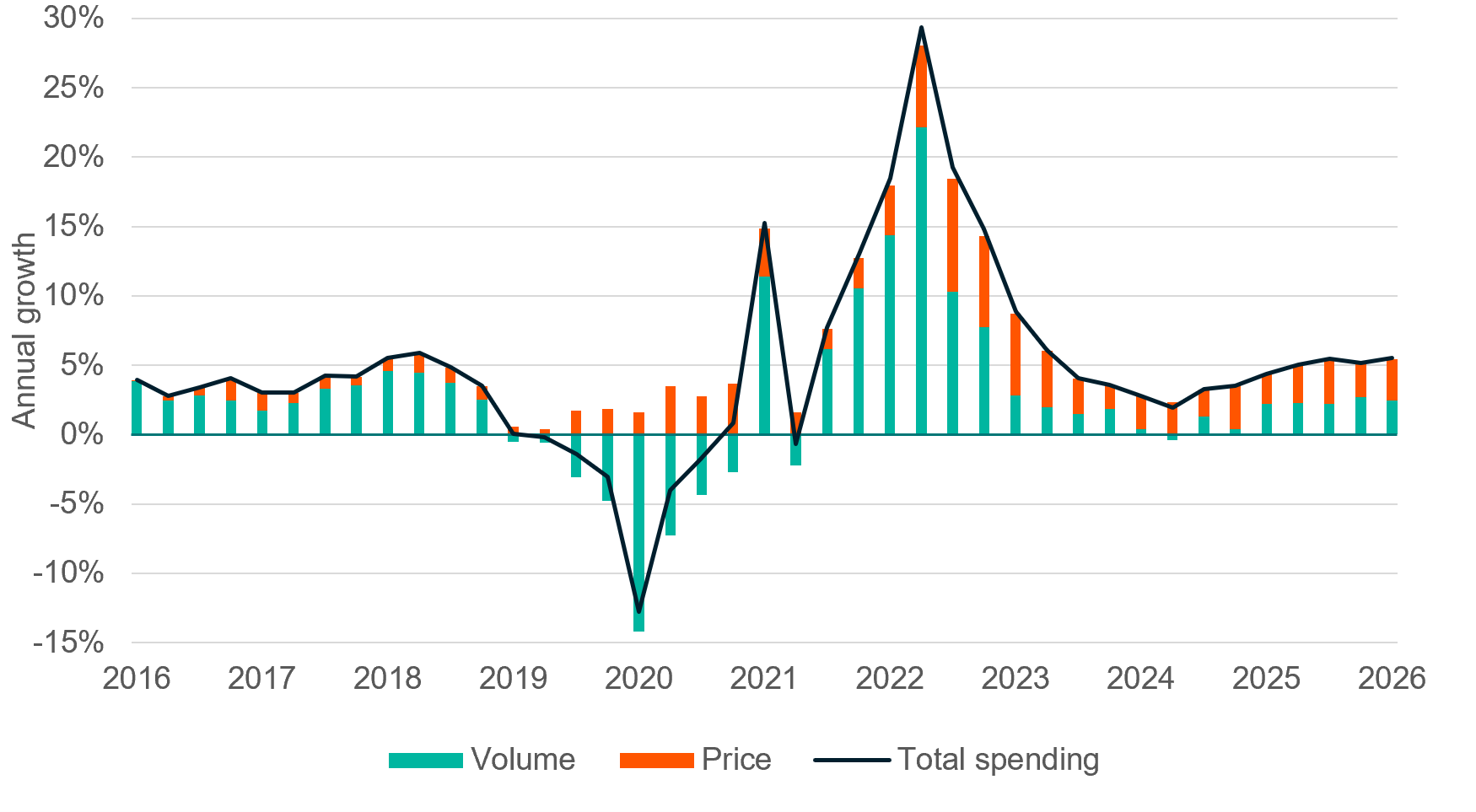
Finally, household spending continues to hold up well despite the higher rate environment growing 5.5% for the year to June comprising 2.4% in volume growth and 3% in higher prices. Discretionary categories such as hospitality and recreation continue to see volume spending well above the pre-pandemic trend.
Quarterly household spending (Jun-17 to Jun-26)
Source: ABS, PPSPW calculations
Partly this reflects the strength of the jobs market with most people seeking a job being able to find it and thereby contribute to overall consumption. Recent decisions such as the 4.75% uplift in the minimum wage from July affecting almost 3 million workers further exacerbate this trend[4]. In addition, the higher rate environment is a double-edged measure with only 35% of households according to the 2021 census owning a home with a mortgage[5]. This leaves a sizeable portion of households that benefit from the higher rate environment with higher returns on savings balances and other investments such as government bonds where the rise in yields translates into higher income and spending power. This could be a factor dampening the RBA’s ability to throttle demand through rate hikes.
In summary the Australian economy showed signs of resilience with household spending accelerating and still-tight labour market conditions persisting. This strength has come at a cost with inflationary pressures also becoming seemingly embedded. This backdrop will pressure the RBA in our view although there is a reasonable prospect that Budget headwinds to credit growth with a slowing housing market coupled with geopolitical fears may see it revise its economic outlook lower and remain on hold.
[1] “Trump says Iran Talks Going Well as Hopes Rise for Hormuz Deal”, Bloomberg, 4 August 2026: Qatar Signals Progress Toward Short-Term Deal Between US, Iran – Bloomberg
[2] “Covert Mideast oil flows are keeping global prices in check”, Fortune, 16 August 2026: Covert mideast oil flows are keeping global prices in check | Fortune
[3] “Dedicated plan aims to up consumption”, China Daily, 5 August 2026: Dedicated plan aims to up consumption – Chinadaily.com.cn
[4] “Business warns 4.75pc minimum wage rise could push up inflation, rates”, Australian Financial Review, 2 June 2026: Business warns 4.75pc minimum wage rise will push up prices, inflation, interest rates
[5] “By the numbers: Australian Home Ownership & Tenancy”, Savings.com.au, 5 March 2026: Australian Home Ownership & Rent Statistics