

Key points
- Chinese brands are rapidly reshaping Australia’s car market through scale, technology and price.
- Model availability is expected to jump from 72 to 120 by 2027, intensifying competition.
- Fleet sales represent the next major growth opportunity for Chinese OEMs.
China’s export surge is not a passing supply event. It is a structural reset of the car market, and Australia is at the front of it. Chinese OEMs are using scale, speed, technology and price to move from fringe challengers to serious volume competitors, and the effects are already showing up in dealer accounts.
In June 2026, China exported more than one million vehicles in a single month for the first time, up more than 75 per cent year on year. This is not only an EV story. Chinese brands are shipping full ranges across EV, plug-in hybrid, hybrid and petrol platforms, and Australia’s open, right-hand-drive market is a natural destination for that volume.
The scale behind that surge is worth pausing on. China now produces the bulk of the world’s vehicles, is exporting at record pace, and has built a new-energy base that dwarfs most national markets. These are the numbers reshaping global supply, and by extension the cars and prices arriving in Australia.
China automotive industry: key indicators, July 2026
| Metric | Statistic |
| Maximum production (installed) capacity | 45m to 55m units |
| Actual output CY2025 | 34.5m units, up 10.4% on 2024 |
| NEV production | 15m+ units |
| Domestic sales | 27.6m; 67% domestic brands (~19m), up from 33% |
| China OEM exports | On track for 12m in 2026, up from 7.1m in 2025 |
| Total global production | 75m passenger, 92m including commercial |
| Total global sales | 88.75m with ~20m NEV |
Sources: NY Times, Reuters, Council on Foreign Relations, Automobility, Kalkine Group, IEA and Statista.
Chinese brands have grown from 9.0 per cent of the market to 25.8 per cent in four years. BYD is number three year to date, GWM, Chery and MG sit in the top 10 and Geely is inside the top 15. They now hold 54 per cent of small SUVs, 37 per cent of medium SUVs, 19 per cent of utes, 54 per cent of BEVs and 77 per cent of PHEVs. The weapon is simple: more equipment, more technology and more electrified options at a lower price. Once a well-equipped Chinese model lands thousands of dollars below an incumbent, the whole segment reprices in the customer’s mind.
Brand proliferation is accelerating. Ten Chinese OEMs already sell more than 20 brands here, with about a dozen more coming. Models on sale are set to grow from roughly 72 in 2026 to about 120 in 2027.
Chinese OEMs in Australia: brands and models are multiplying
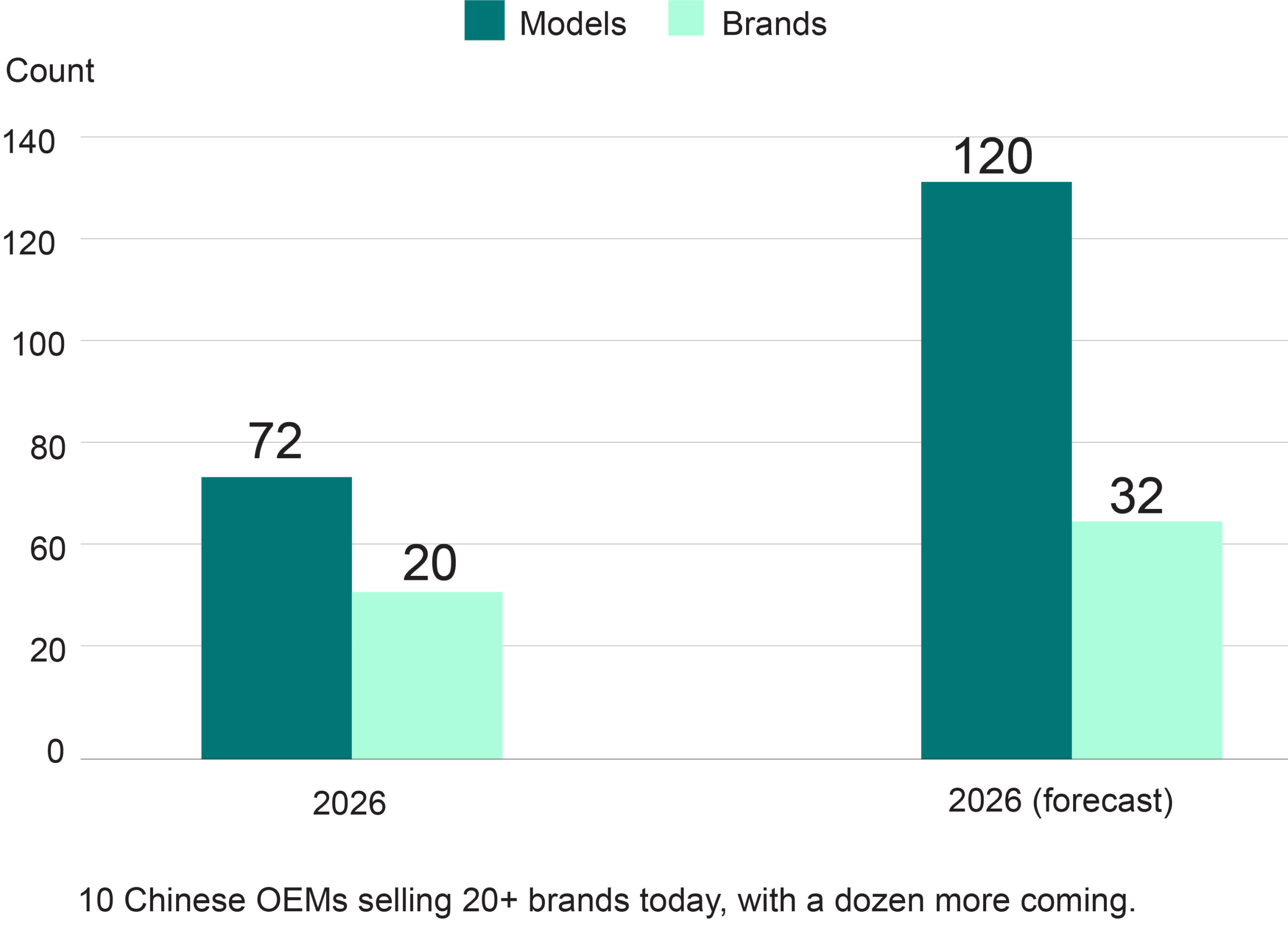
Source: Manheim Cox Automotive; brand and model counts as forecast for 2026 and 2027.
The next growth frontier is fleet. Chinese brands have concentrated on private buyers, and the five most private-weighted brands in the top 20 are all Chinese, while the most fleet-weighted are traditional players such as Ford, Mitsubishi, Toyota, Nissan and Isuzu. As these brands build residual-value track records and fleet servicing networks, business and rental channels become the next leg of share growth.
| Want to understand what China’s export surge means for your dealership?
Pitcher Partners clients can access the full article for practical insights and guidance. |