
Navigating the inevitable: embracing volatility and drawdowns for long-term growth
Pitcher Partners Investment Services (Melbourne) | The information in this article is current as at 1 October 2025
Volatility in financial markets is inevitable. For many investors, the sharp fluctuations in share prices, the unsettling headlines, and the sudden dips in portfolio values can feel like a storm threatening to upend their carefully crafted investment plans. Yet, history teaches us that volatility is not just normal – it is often the price paid for long-term growth.
What is volatility, and why does it matter?
Volatility measures the rate at which the price of a security increases or decreases for a given set of returns. In simple terms, it reflects how much prices move up and down over a period of time. While high volatility can feel unsettling, it also represents opportunity – after all, without price movement, there would be no potential for superior returns.
Short-term volatility is influenced by a multitude of factors: macroeconomic events, geopolitical tensions, company earnings, interest rates changes, technological breakthroughs, and even investor sentiment. These forces can be unpredictable and, at times, feel overwhelming. However, when viewed with a long-term lens, the noise of daily price fluctuation often recedes, revealing a more consistent pattern of growth.
Drawdowns: the emotional test
A drawdown is a decline in the value of an investment from its peak to its trough. Every investor, no matter how experienced, will face drawdowns during their journey. The real test is not whether you will encounter them, but how you respond when they occur.
Consider the following:
- Drawdowns are common: even the best-performing assets experience setbacks. The key is to recognise that these periods are temporary and often pave the way for future growth.
- Emotional reactions can be costly: selling during downturns often solidifies losses and can prevent investors from participating in the subsequent recovery.
- Staying invested pays off: over time, those who remain invested tend to outperform those who try to time the market or react emotionally to volatility.
Amazon: a case study in enduring volatility
Few companies embody the power of long-term investing better than Amazon. Today, Amazon is a household name, a pillar of the global economy, and is valued at over $2 trillion. But its journey has, at times, been anything but smooth.
The early days: massive swings
When Amazon went public in 1997, it was a fledgling online bookstore with little guarantee of success. In 1999-2001, as the dot-com bubble burst, Amazon stock fell from around $106 to under $6 per share – a drawdown of more than 94%. For many investors, this would have seemed like a death knell. Yet, Amazon survived, innovated, and expanded its business into new domains.
Even after its recovery, Amazon’s stock remained volatile. The company’s shares have regularly experienced drawdowns of 30% or more, sometimes within a single year. For example:
- From late 2003 to early 2005, shares declined by approximately 50%.
- During the 2008 financial crisis, Amazon’s share price was cut in half once again.
- Even in recent years, Amazon has faced drawdowns exceeding 20% in the face of market uncertainty, regulatory scrutiny, and changes in consumer behaviour.
A $10,000 investment in Amazon at its IPO, despite the gut-wrenching declines along the way, would have grown to millions of dollars by the 2020s. The lesson? Enduring volatility is often a prerequisite for enjoying exceptional returns.
While Amazon’s story is inspiring, it is not unique. Apple experienced multiple near-death moments in the 1990s, only to become one of the most valuable companies in history. Microsoft suffered through years of stagnant share price performance in the early 2000s, only to surge as cloud computing and new technologies took centre stage.
The long-term perspective pays dividends
Looking at broader market indices, the story is much the same. The S&P 500, for example, has experienced dozens of double-digit corrections since its inception. Yet, the index has delivered an average annual return of around 10% over the last century, turning even modest, consistent investments into substantial wealth over time. The 2008 financial crisis wiped trillions of dollars from global markets, yet those who held on recovered and thrived in the ensuing decade.
Many investors are tempted to “time the market” by selling assets during downturns and buying back in when things look brighter. However, studies consistently show that missing just the best 10 days in the market over a 20-year period can cut your total returns by more than half. These “best days” often occur amid – or immediately after – the worst days. Staying invested, through thick and thin, is crucial.
Compound growth rewards patience. By reinvesting gains year after year, investors can turn even small differences in annual returns into dramatic differences in wealth over decades. Volatility, while intimidating in the short term, is often the engine that drives compounding in the long run.
Investing legends like Warren Buffett and Charlie Munger often describe compounding as one of the most powerful forces in investing. Buffett has said that the most important factor in wealth creation isn’t necessarily earning extraordinary returns but rather earning decent returns and letting them compound over a long period.
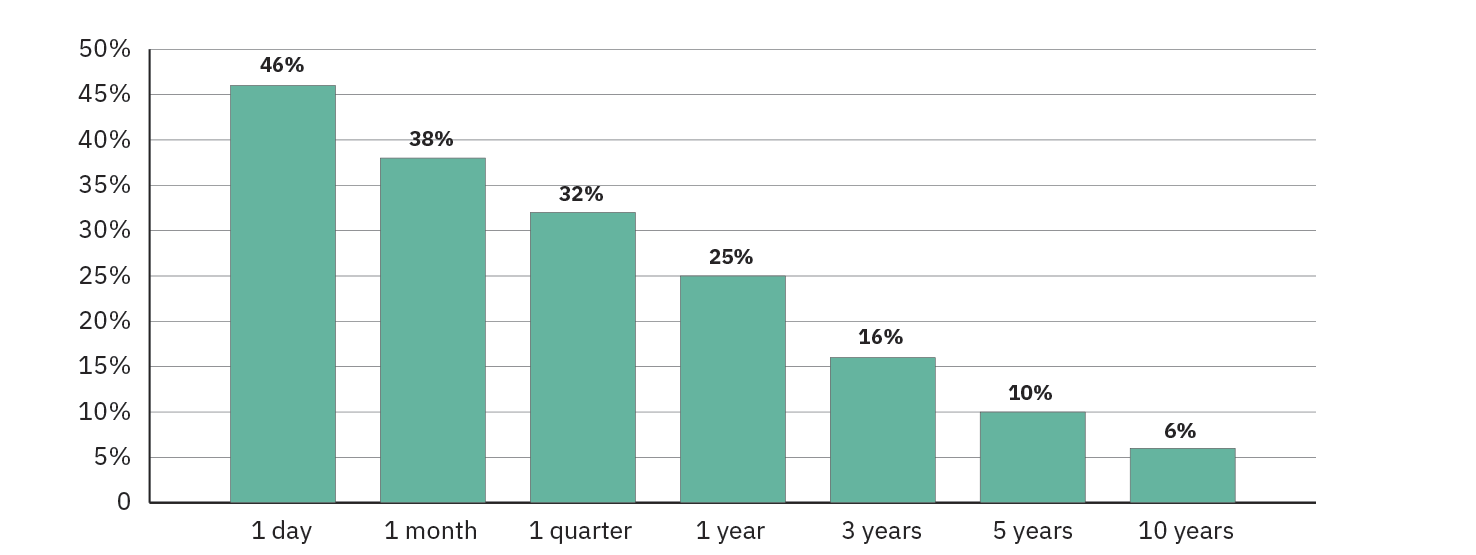
Probability of negative returns, based on S&P total returns from 1929-present
The bottom line: volatility is the price of admission
If investing came with guarantees and no risk, the rewards would be meagre. Volatility and drawdowns are the “price of admission” for the possibility of higher returns. For investors with a long-term view, these bumps in the road should be expected, not feared.
It is also worth remembering that every dip in the market has historically been followed by a recovery – and often a new high. While the day-to-day gyrations can be uncomfortable, they are ultimately what makes meaningful wealth creation possible.
One of the most crucial lessons for investors is the futility of market timing. Attempts to “time the market” often result in “buying high and selling low”. History shows that predictions about future market movements are frequently wrong, and the market is incredibly efficient, constantly pricing and repricing data as it becomes available. Trying to exploit perceived market inefficiencies by timing entries and exits is more about luck than skill.
Embrace the journey
In the end, successful investing is less about avoiding volatility and more about embracing it as part of the process. The stories of Amazon, Apple, Microsoft, and countless others remind us that the real winners are those who stay focused on the long-term horizon, ride out the storms, and allow time and compounding to work their magic.
It is important to remember that temporary drawdowns are not a sign of failure, but a reflection of the market’s dynamic nature. The potential rewards of long-term investing, and letting the power of compounding do the work for you, far outweigh the discomfort of short-term swings.
Volatility is not always a negative force; it can present opportunities. Volatility is the cost of compounding as it accurately describes how you cannot have one without the other. Staying invested during volatile periods typically benefits those with a long-term view, as quality companies with strong fundamentals often emerge even stronger.