

Key points:
-
New Vehicle Efficiency Standard (NVES) applies to most passenger vehicles and light commercial vehicles under 4.5 tonnes, with compliance responsibility sitting with the party that holds type approval and first enters the vehicle onto the RAV.
-
The unit trading scheme is the core compliance mechanism, allowing suppliers that outperform emissions targets to bank or trade efficiency units, while others must purchase units or absorb penalties that are typically passed on to consumers.
-
Emissions targets tighten sharply through to 2029 and are enforced over a multi-year compliance timeline, giving suppliers time to adjust but setting up increasing pressure, pricing signals and market distortion as unit transparency emerges.
What the NVES covers
NVES applies broadly to:
- Type 1 passenger vehicles: sedans, hatchbacks and most SUVs
- Type 2 light commercial vehicles (LCV): vans, utes and some heavier SUVs
Responsibility sits with the party holding vehicle type approval (under the RVSA, 2018) and entering the vehicle onto the RAV for the first time in the relevant compliance year (gross mass under 4.5 tonnes). The regime is designed to capture overseas manufacturers entering covered vehicles onto the RAV which is critical given Australia’s import reliance.
The unit trading scheme – NVES’s design feature that matters most
Suppliers that outperform their emissions targets earn “efficiency units” that can be banked for future years or traded to offset excess emissions. This mirrors the logic of carbon credit markets and introduces a compliance currency within the new vehicle supply chain, rewarding early movers with strong low‑emissions portfolios.
For suppliers without a credible pathway to generating units internally, options narrow to purchasing units or accepting penalties which is typically passed on to consumers.
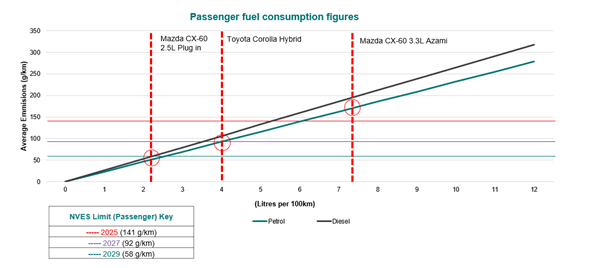
Targets through 2029 – converted to what drivers understand
- Type 1 (Passenger):
- 2025 target: 141 g/km ≈ 7.2 L/100km
- 2029 target: 58 g/km ≈ 2.1 L/100km
→ Practically, vehicles without plug‑in capability (BEV/PHEV) will struggle to qualify in 2029.
- Type 2 (LCV):
- 2025 target: 210 g/km ≈ 7.8 L/100km
- 2029 target: 110 g/km ≈ 5.0 L/100km
→ This pressures Australia’s most popular LCV models unless significant efficiency gains are achieved.

Compliance is a timeline, not a single moment
- Interim emissions value calculated on 1 February following the compliance year ending 31 December.
- If positive, suppliers have two additional years to extinguish enough units to reach zero by the final reconciliation date.
- Failure triggers penalties: final emissions value × $100.
This structure gives suppliers time to manage their position but also creates a clear runway for unit supply/pricing distortions as the NVES Unit Registry becomes transparent (from February 2026).
More resources